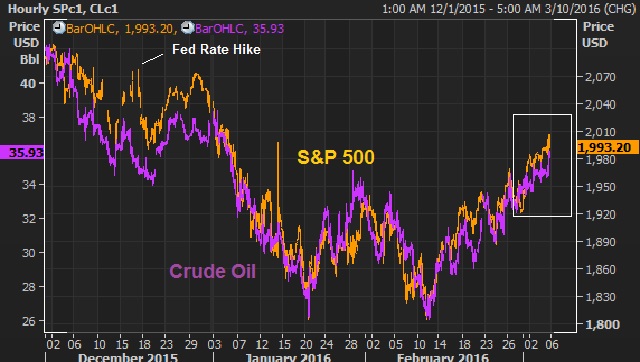
Yesterday, SandRidge Energy was yet another energy company to file for bankruptcy this year. Many hear bankruptcy news and think of failed companies. But in plenty of cases, it’s more about opportunism than it is about desperate last acts.
Before we talk about the SandRidge story, we want to give some bigger picture context.
As we discussed a few months ago, the oil price bust, while many thought would be a positive for the economy, because it puts a few bucks in the pockets of consumers, has actually been a huge net negative, because it has brought the energy industry to its knees.
If oil stayed at $26, the shale industry in the America would be done. All of the associated businesses (transportation, logistics, refining, housing, marketing, etc.) – done. Hundreds of thousands of jobs were lost already, and probably millions would have followed. Guess who lends money to the energy sector? Banks. The financial system would once again have been in widespread crisis.
Oil producing countries like Venezuela and Russia would have defaulted. When a biggie like Russia goes, it has systemic ramifications. That event would have likely pulled the leg out from under the teetering European debt crisis chair. From there, Greece would have gone, and Italy and Spain would have probably defaulted. The European Monetary Union would have then finally succumbed to the unmanageable weight of the crisis.
To sum up, cheap oil would have been far worse than the sub-prime crisis. And this time, central banks and governments would have had no ammunition to fight it.
But, central banks stepped in to remove the “cheap oil” risk. The Bank of Japan intervened in the currency markets, and oil bottomed that day. China followed by ramping up bank lending. And Chinese institutions have been big buyers of commodities since. Then the ECB rolled out bigger and bolder QE. And the Fed removed two projected rate hikes from the table. All of this coordinated to directly or indirectly put a floor under oil. Today, oil is up 85% from levels of just three months ago.
So this begs the question: Why is an energy company like SandRidge, a company that has been surviving through the decline in oil prices, cutting production/cutting jobs, now filing bankruptcy? This is AFTER oil has bounced 85% and oil supply has just swung from a surplus to a deficit. And some of the best oil traders in the world are projecting oil prices back around $80 by the end of the year. Why would they throw in the towel now and not in February?
Back in February, SandRidge management missed a debt payment, opting to exercise a 30-day grace period. It was at that stage that the ultimate negotiation should have come with debt holders. Option 1): Restructure debt and perhaps dilute current shareholders by offering debt holders common shares. That gives the company time to ride out the storm of the oil price bust. And it gives all stakeholders a chance to see much better days. Option 2): Close the doors and liquidate assets, and creditors get cents on the dollar.
Instead, SandRidge management and directors negotiated more runway so that they could get to Option 3): the homerun lottery ticket.
In this option, oil prices recover and the company can begin producing profitably again, and brighter days are ahead. But if they rush to file Chapter 11 bankruptcy, while the business fundamentals remain depressed, they can win big. By swapping new stock for debt, the company gets freed of the noose of debt, and the debt holders exchange a piece of paper that was once worth pennies on the dollar, for common stock in a super-charged debt-free company.
That sounds like a win-win. The company continues to operate as normal. Management and the board keep their jobs (and likely their golden parachutes). And former debt holders can make a lot of money.
Who pays the price? Shareholders (the owners). Old shareholders of SandRidge stock have no say in the collusion between SandRidge leadership and creditors. So the owners of the company have their interests effectively stolen by a backroom deal and given to debt holders. And within the bankruptcy laws of Chapter 11, shareholders have no leverage. But who are some of the biggest and most effected shareholders? Employees.
SandRidge has over 1,000 employees. Let’s assume that, like many publicly traded companies, employees of SandRidge have been incentivized to buy company stock as part of their 401k plan (common practice). They have already seen their stock go from $80 to pennies. But now, as an insult to injury, they will continue working to enrich new shareholders while their board of directors have chosen to wipe out their interests.
And sadly, the common stock of companies like SandRidge (which was one of the most shorted stocks on the NYSE) are often shorted heavily by those that own the debt, in efforts to drive the company into Chapter 11, so that they can orchestrate precisely what’s happening today. The stock price gets cheap, then delisted from a major exchange, then credit ratings get downgraded, then banks cut credit lines, and voila, the company find itself in a liquidity crunch and turns to restructurings.
A huge factor in this “homerun option” for the board and creditors is for the company to continue operating as normal. If employees in this Chapter 11 situation would strike, maybe shareholders could have a seat at the negotiating table when these “pre-arranged” reorganization deals are cut. Still, that’s the leverage they hold to derail such a deal.
Consider this: In the depths of the real estate bust, billionaire activist investor Bill Ackman stepped in and bought beaten down shares of General Growth Properties, a company in bankruptcy because it couldn’t access credit. The company had strong assets and strong cash flow (as does SandRidge), but was dependent on a functioning credit market, which was broken at the time. As the largest shareholder, he battled in the board room for the shareholder. He helped management access liquidity and he convinced all stake holders that keeping equity holders intact would result in the biggest outcome for everyone. He was right, and when the credit markets recovered, GGP shares went from 20 cents to over $20 a share.
Join us here to get all of our in-depth analysis on the bigger picture, and our carefully curated stock portfolio of the best stocks that are owned by the world’s best investors.
We’ve talked a lot about oil, the rebound of which has probably led to the trade of the year. If you recall back on February 8th, we said policymakers finally got the wake up call on the systemic threat of the oil price bust when Chesapeake Energy, the second largest oil and gas producer, was rumored to be pursuing bankruptcy.
This is what we said:
“The early signal for the 2007-2008 financial crisis was the bankruptcy of New Century Financial, the second largest subprime mortgage originator. Just a few months prior the company was valued at around $2 billion.
On an eerily similar note, a news report hit this morning that Chesapeake Energy, the second largest producer of natural gas and the 12th largest producer of oil and natural gas liquids in the U.S., had hired counsel to advise the company on restructuring its debt (i.e. bankruptcy). The company denied that they had any plans to pursue bankruptcy and said they continue to aggressively seek to maximize the value for all shareholders. However, the market is now pricing bankruptcy risk over the next five years at 50% (the CDS market).
Still, while the systemic threat looks similar, the environment is very different than it was in 2008. Central banks are already all-in. We know, and they know, where they stand (all-in and willing to do whatever it takes). With QE well underway in Japan and Europe, they have the tools in place to put a floor under oil prices.
In recent weeks, both the heads of the BOJ and the ECB have said, unprompted, that there is “no limit” to what they can buy as part of their asset purchase program. Let’s hope they find buying up dirt-cheap oil and commodities, to neutralize OPEC, an easier solution than trying to respond to a “part two” of the global financial crisis.”
Chesapeake bounced aggressively, nearly 50% in 10 business days.
And on February 22nd, we said, “persistently cheap oil (at these prices) has become the new “too big to fail.” It’s hard to imagine central banks will sit back and watch an OPEC rigged price war put the global economy back into an ugly downward spiral. And time is the worst enemy to those vulnerable first dominos (the energy industry and weak oil producing countries).”
As we’ve discussed, central banks did indeed respond. The BOJ intervened in the currency markets on February 11, and that (not so) coincidently put the bottom in oil and global stocks. China followed on February 29, with a cut on bank reserve requirements, then ECB cut rates and ramped up their QE and the Fed joined the effort by taking two projected rate cuts off of the table (we would argue maybe the most aggressive response in the concerted central bank effort).
From the bottom on February 8th, Chesapeake shares have gone up five-fold, from $1.50 to over $7. Oil bottomed February 11 and is up 77%. This is the trade of the year that everyone should have loved. If you’re wrong, the world gets very ugly and you and everyone have much bigger things to worry about that a bet on oil and/or Chesapeake. If you’re right, and central banks step in to divert another big disaster (a disaster that could kill the patient) you make many multiples of your risk.
We think it was the trade of the year. The trade of the decade, we think is buying Japanese stocks.
Overnight the BOJ made no changes to policy. And the dollar-denominated Nikkei fell over 1,200 points (more than 7%).
As we said yesterday, two explicit tools in the Bank of Japan’s tool box are: 1) a weaker yen, and 2) higher stocks. I say “explicit” because they routinely have said in their minutes that they expect both to contribute heavily to their efforts. So now Japanese stocks and the yen have returned near the levels we saw before the Bank of Japan surprised the world with a second dose of QE back in October of 2014. So their efforts have been undone. And they’ve barely moved the needle on their objective of 2% inflation during the period. In fact, the head of the BOJ, Kuroda, has recently said they are still only “halfway there” on reaching their goals.
So they have a lot of work left. And if we take them at their word, a weak yen and higher stocks will play a big role in that work. That makes today’s knee-jerk retreat in yen-hedged Japanese stocks a gift to buy.
U.S. stocks have well surpassed pre-crisis, record highs. German stocks have well surpassed pre-crisis, record highs. Japanese stocks have a long way to go. In fact, they are less than “halfway there.”
Join us here to get all of our in-depth analysis on the bigger picture, and our carefully curated stock portfolio of the best stocks that are owned by the world’s best investors.
Heading into today’s inflation data, the prospects of German 10-year government interest rates going negative had added to the heightened risk aversion in global markets. And we’ve been talking this week about how markets are set up for a positive surprise on the inflation front, which could further support the mending of global confidence.
On cue, the euro zone inflation data this morning (the most important data point on inflation in the world right now) came in better than expected. We know Europe, like Japan, is throwing the kitchen sink of extraordinary monetary policies at the economy in an effort to reverse economic stagnation and another steep fall into deflation. And we know that the path forward in Europe, at this stage, will directly affect that path forward in the U.S. and global economy. So, as we said in one of our notes last week, the world needs to see “green shoots” in Europe.
With the better euro zone inflation data today, we may be seeing the early signs of a bottom in this cycle of global pessimism and uncertainty. German yields are now trading double the levels of Monday. And with that, U.S. yields have broken the downtrend of the month, as you can see in the chart below.
Source: Billionaire’s Portfolio, Reuters
With that in mind, today we want to talk about how we can increase certainty in an uncertain world. Aside from the all-important macro influences, even when you get the macro right, when your investing in stocks, you also have to get a lot of other things right, to avoid the landmines and extract something more than what the broad tide of the stock market gives you (which is about 8% annualized over the long term, and it comes with big drawdowns and a very bumpy road).
In our Billionaire’s Portfolio, we like to put the odds on our side as much as possible. We do so by following big, influential investors into stocks where they’ve already taken a huge stake in a company, and are wielding their influence and power to maximize the probability that they will exit with a nice profit.
This is the perfect time to join us in our Billionaire’s Portfolio. We’ve discussed our simple analysis on why broader stocks can and should go much higher from here. You can revisit some of that analysis here. In our current portfolio, we have stocks that are up. We have stocks that are down. We have stocks that are relatively flat. But they all have the potential to do multiples of what the broad market does. And for depressed billionaire-owned stocks, a broad market rally and shift in economic sentiment should make these stocks perform like leveraged call options – importantly, without the time decay. Join us hereto get your portfolio in line with ours.
We talked this week about the way markets are set up for a significant positive perception shift. It’s been led by oil, which had its third consecutive close above $40 today. Yields are another key brick in the foundation that may be laid tomorrow.
As oil prices have been a threat to the global economic and stability outlook over the past few months, yields have also been sending a negative signal to markets. The yield on the German 10-year got very close to the all-time lows this week, inching closer to the zero line (and negative territory). And U.S. 10-year yields, following the Fed’s last meeting, have fallen back from 2% down to as low as 1.68% — just 30 basis points above the all-time low of July 2012, when Europe was on the edge of a sovereign debt blow-up. And remember, this is AFTER the Fed has raised rates for the first time in nine years.
So yields have been signaling an uglier path forward, if not deflation forever in places like Japan and Europe. Of course, the move by Japan to negative interest rates in January was a strong contributor to the perception swoon about the global economy. But a key component in Japan’s move, and in the coordinated actions by central banks over the past two months, has been the threat from the oil price bust. And that is now on the mend. Oil is up 58% from its February low.
Still, global yields are hanging around at the lows.
Tomorrow we get euro zone and U.S. inflation data. As we’ve said, when expectations and perception has been ratcheted down so dramatically, we can get an asymmetric outcome. Earnings expectations are in the gutter. Economic growth expectations are in the gutter. Same can be said for expectations on the outlook for inflation data. In a normal world, hotter than expected inflation is a bad signal for the risk-taking environment. In our current world, hotter than expected inflation would not be a good signal, it would be a very good signal. It would show the economy has a pulse.
Yields in the two key government bond markets are set up nicely for a bottom on some hotter inflation data.
Tuesday, German yields touched 7.5 basis points. Remember, earlier in the month we talked about what happened the last time German yields were this low.
Bond kings Bill Gross and Jeffrey Gundlach said it was crazy. Bill Gross called the German bund the “short of a lifetime” (short bonds, which equates to a bet that yields go higher). He compared it to the opportunity when George Soros broke the Bank of England and made billions shorting the British pound. Gundlach said it was a trade with almost no upside and unlimited downside.
They were both right. In the chart below you can see the explosive move in German rates (in blue) away from the zero line. In the chart below, you can see the 10-year German bond yields moved from 5 basis points to 106 basis points in less than two months — a 20x move. U.S. 10 year yields (the purple line) moved from 1.72% to 2.49% almost in lock-step.
On the move down on Tuesday, the yield on the German bund reversed sharply and put in a bullish outside day (a key reversal signal). Could it have been the bottom into tomorrow’s inflation data?
Coincidentally, the U.S. 10-year looks like a bottom may be in as well.
U.S. yields have a chance to break this downtrend tomorrow on a hotter inflation number.
As we said yesterday, in addition to oil, these are very important charts for financial markets and for the global economic outlook. A bottom in these yields, as well as the continued recovery in oil will be important for restoring confidence in the global economic outlook.
This is the perfect time to join us in our Billionaire’s Portfolio. We have just added the billionaire’s macro trade of the year to our Billionaire’s Portfolio — a portfolio of deep value stocks owned by the best billionaire investors in the world. You can join us here.
As we said yesterday, oil on the mend is the key proxy right now for global economic stability. With that, after closing above $40 yesterday, oil continued its surge today, up 4%. And global stocks had a good day, up 1% in the U.S.
Remember, we get key inflation data over the next couple of days, namely from Europe and the U.S. A hotter inflation number in the U.S. would further support the signal that oil is giving to markets (a positive one).
Today we want to look at a few of very key charts. This first chart is an update on the crude oil/stock market relationship. We’ve looked at this a few times over the past few months. The last time we revisited this chart, oil and stocks had started to diverge from stocks with its recent move back into the mid 30s.
So oil is sustaining above $40 for the first time since November. We know three of the top oil traders in the world are betting on $70-$80 oil by next year. We know central banks have stepped in (in coordination) since the low in oil on February 11 and the result has been a 50%+ bounce in oil. Now, technically, oil looks like a technical breakout is here.
In the above chart, you can see oil breaking above the high of March 22 (which was 41.90). In fact, we get a close above that level – technically bullish. And we also now have a technically bullish pattern (an impulsive C-wave of an Elliott Wave structure) that projects a move to $51.50, which happens to be right about where this big trendline comes in.
Now, with the inflation data in the pipeline for the week, we’ve talked about the negative signal that ultra-weak yields are sending to markets. And German yields have been leading the way on that front. But guess what? German yields reversed sharply off of the lows yesterday, and continued higher today, putting in a long term bullish reversal signal (an outside day – technical jargon, but can be very predictive of tops and bottoms). And that coincides with the U.S. 10-year yield, which is on the verge of breaking the recent downtrend and projecting a move back to 2.15%. We’ll take a look at these very important charts for financial markets and for the global economic outlook tomorrow.
These key markets are signaling what could be the beginning of a big shift in sentiment and the beginning of positive surprises in markets and economies, which tends to happen when expectations have been ratcheted down so dramatically, as we discussed yesterday with the sour earnings outlook and pessimistic economic backdrop.
This is the perfect time to join us in our Billionaire’s Portfolio. We have just added the billionaire’s macro trade of the year to our Billionaire’s Portfolio — a portfolio of deep value stocks owned by the best billionaire investors in the world. You can join us here.
Intervention has been the common theme we’ve discussed for the better part of the past two months. And this week, that theme is heating up.
We’ve explained why oil at $30 has posed a threat to the global financial system and global economy. And we explained the parallels of the systemically threatening (current) oil price bust and the 2007-2008 housing bust. But we also noted the key differences, and why and how this “cheap oil” problem could be easily solved, unlike the housing bust.
Buffett’s famed annual letter is due to be released this weekend. With that, today we want to talk a bit about his record, his philosophy on markets and successful investing and the high conviction stocks that he has in his $130 billion plus Berkshire Hathaway stock portfolio.
First, only one living investor has a length of track record that can compare to Buffett’s. That’s fellow billionaire Carl Icahn. Icahn actually has a better record than Buffett, and it spans a little longer. But he gets a fraction of the attention of the man they call the Oracle of Omaha.(more…)
Today the rebound in oil led a significant turnaround for stocks. With that, the broader sentiment of uncertainty across markets tends to abate. Broader commodities swung from negative to positive. And yields on the U.S. 10-year Treasury, which were in deep decline this morning, swung to positive territory by the afternoon.
If you own stocks, a house, have a job or need to eat, you should cheer for higher oil prices.
As we’ve talked about quite a bit in recent weeks, cheap oil, at this point in the global economic recovery, is a catalyst to destabilize the global economy. While consumers gain a few bucks from cheaper gas, the oil industry leans closer to the edge of bankruptcies and weak oil exporting countries toward default. That would be very bad news (global financial crisis, round 2). So the longer we’re down here, and the more persistent these low levels appear, the riskier the world looks. And when the world looks risky, people sell stocks, and other relatively risky assets and they hold cash or buy U.S. Treasuries (which pushes yields lower).
For proof, here’s a look at the 10-year yield on the U.S. Treasury note.
Keep in mind, the Fed raised rates in December! They did so when the 10 year was trading at a yield of 2.20%. The yield is now 45 basis points lower. And even though a voting Fed member said yesterday that in her view, a second hike was still on the table for next month, the market has still virtually priced out the possibility of any further hikes for the rest of the year.
Why? Because other parts of the world are moving (or are moving deeper) into negative rate territory, because economic conditions continue to soften, mostly driven by sentiment and weakening inflation prospects. A big driver of that mix is the oil price crash.
In the next chart, you can see how yields, despite the December rate hike, have tracked oil lower.
Again, when people think the world looks risky, they pile into the safest parking place for capital on the planet, U.S. Treasuries –and that drives yields on Treasuries lower. While that flow of capital has certainly occurred, the pressure on yields from speculators is also a big component.
If you recall, we discussed a couple of weeks ago how markets can have it wrong – sometimes very wrong. If indeed, the market is wrong on this one, there is a tremendous opportunity to ride yields back to the 2.25% area. And it may be a violent move.
But oil will be the driver.
As we said, oil turned the tide for stocks today. Here’s a look at the relationship of oil and stocks over the past three months.
In this longer term chart above, you can get perspective on where oil prices stand relative to history. You can see in this chart the sharp rise, the sharp fall and the rebound from the depths of the global financial crisis.
That rebound was all China. China stepped in and used their three trillion dollars in foreign currency reserves AND their massive fiscal stimulus package to gobble up cheap commodities.
And you can see this most recent price crash was triggered by move by the Saudis to block an OPEC production cut in November 2014. It was the night of the Thanksgiving holiday in the U.S. and oil was trading about $73. We haven’t seen that price since.
The low at the depths of the financial crisis was 32.40. That’s about where oil closed today. We’ve made the case in recent weeks that, if OPEC refuses to cut production (likely), the central banks could/should step in and buy oil (the ECB, BOJ and/or China).
Bryan Rich is a macro trader and co-founder of Billionaire’s Portfolio,a subscription-based service that empowers average investors to invest alongside the world’s best billionaire investors.
People continue to blame softness in global markets on China. For years, there has been fear and speculation of “hard landing” for the Chinese economy.
When we talk about China, it’s all relative. China was growing at double digit pace for the better part of the past 25 years. Now Chinese growth has dropped to below 7%. That’s recession-like territory for the Chinese economy.
But the Chinese have powerful tools to promote growth. And we expect them to use those tools, sooner rather than later.
As we know their biggest and most effective tool is their currency. They ascended to the second largest economy in the world over the past two decades by massively devaluing their currency, and then pegging it at ultra-cheap levels. It allowed them to corner the world’s export market, sucking jobs and valuable foreign currency out of the developed world. This is precisely what Donald Trump is alluding to when he says “China is stealing from us.”
Interestingly though, it’s China, most recently, that has been getting hurt by currency. Over the past four years, the Bank of Japan has devalued their currency against the dollar by nearly 40%. And other export-driven emerging market economies have had massive declines in their currencies (Brazil, Mexico, Argentina, Russia). Given that China has actually been appreciating its currency against the dollar for the past 10 years (albeit gradually), they’ve given back a lot of ground on their export advantage.
Source: Reuters, Billionaire’s Portfolio
In the chart above, you can see the yen weakening dramatically against the dollar (the purple line moving higher = stronger dollar, weaker yen). The orange line is the dollar vs. the Chinese yuan. You can see the relative advantage that the BOJ’s QE program has created (the gap between the purple and orange lines). With that, the orange line rising, since 2014, represents China backing off of its pledge to appreciate its currency. They are fighting to preserve their export advantage by weakening the yuan again.
In August, they devalued by less than 2% in a day and global markets went haywire. That move is nothing extreme in currencies, especially an emerging market currency. But given China’s currency history and their policy stance, since 2005, to allow their currency to appreciate under a “managed float” (managing a daily range for the currency), it has markets confused. When people are confused, they “de-risk” or sell.
Now, China will likely continue this path. Our bet is that markets will finally realize that, in the shorter term, this will be good for global growth and good for the health and stability of global financial markets. Better growth in China, at this stage, is good.
Among their other tools to stimulate growth, China has interest rates. While most of the world is pegged at zero rates (or close to it, if not negative) China’s benchmark interest rate is still 4.35%. And their inflation rate is running 1.5%, well below their target of 3%. That’s a recipe for aggressive rate cuts, which would be a boon for the Chinese economy and for the global economy.
We have an explosive growth Chinese internet stock in our Billionaire’s Portfolio that is positioned to benefit from aggressive Chinese policy moves. We are following one of the best billionaire technology investors on the planet. He has a massive stake in the company. Click here to join us!
Oil has surged to open the week. If you’ve been reading our daily pieces over the past few weeks, you’ll know how important oil is for global markets at this stage. With that, strong oil today has translated into higher stocks, higher broad commodities, a slight bump higher in interest rates and better investor sentiment in general.
It was just fourteen days ago that Chesapeake Energy, one of the largest producers of oil and natural gas was rumored to be choosing the path of bankruptcy. That rumor was immediately denied by the company. And soon thereafter, the reality set in for markets that a scenario like that would conjure up post-Lehman like outcomes. Oil has since put in a bottom and bounced more than 25%. Chesapeake has now bounced 46% from the lows just the last six trading days.
It’s at extremes in markets where the biggest and best investors have historically made their money – running into risk, when everyone else is running away.
With that, today we want to take a look at a few stocks with the biggest upside, and an important “risk buffer” in what is a high risk sector at the moment (energy). This risk buffer? Each stock has the presence of a big-time billionaire investor.
Self-made billionaire energy trader Boone Pickens has said he expects oil to return to $70 this year. On his $70 prediction, he’s also said that if he misses it will be because oil is “over $70, not under $70.” If Pickens is right about oil prices, each of these stocks below have huge upside:
1) Oasis Petroleum (OAS) – Billionaire hedge fund manager John Paulson owns nearly 4% of this stock. The activist hedge fund SPO Advisory owns 14% and has been buying the stock on almost every dip. When oil was last $70, OAS was trading $25 or 500% higher than current levels.
2) Chesapeake Energy (CHK) – Billionaire investor Carl Icahn owns 11% of CHK and recently added to his position around $13. The last time oil was $70, Chesapeake was $25. That would be more than a 1000% return from its price today.
3) EXCO Resources (XCO) – Billionaire investors Wilbur Ross and Howard Marks own more than 30% of this energy stock. The last time oil was $70, EXCO was $3.30. That would be almost a 330% return from its price today.
4) Consol Energy (CNX) – Billionaire David Einhorn owns 12.9% of this stock. When oil was last $70, Consol traded for $40 or almost 500% higher than current levels.
5) Williams Companies (WMB) – Carl Icahn Protégé, Keith Meister of the activist hedge fund Corvex Management, owns $1.1 billion worth of WMB. The last time oil was $70, WMB traded for $50 – more than 300% higher than its current levels.
As we’ve said, persistently cheap oil (at these prices) has become the new “too big to fail” — it’s a systemic risk. It’s hard to imagine central banks will sit back and watch an OPEC-rigged price war put the global economy back into an ugly downward spiral. And time is the worst enemy to those vulnerable first dominoes (the energy industry and weak oil producing countries).
The best investors like to go where the biggest risks are — that’s where the biggest returns can follow. And they’ve been getting aggressive in energy and commodities.
Without question, energy stocks have been beaten up and left for dead. If indeed Chesapeake is a leading indicator that it’s all backing away from the edge, there will be big money to be made in these stocks.
We already have one of the best performing stocks in the entire stock market for the month of February in our Billionaire’s Portfolio, billionaire-owned Freeport McMoran. Click here and join us!

 Heading into today’s inflation data, the prospects of German 10-year government interest rates going negative had added to the heightened risk aversion in global markets. And we’ve been talking this week about how markets are set up for a positive surprise on the inflation front, which could further support the mending of global confidence.