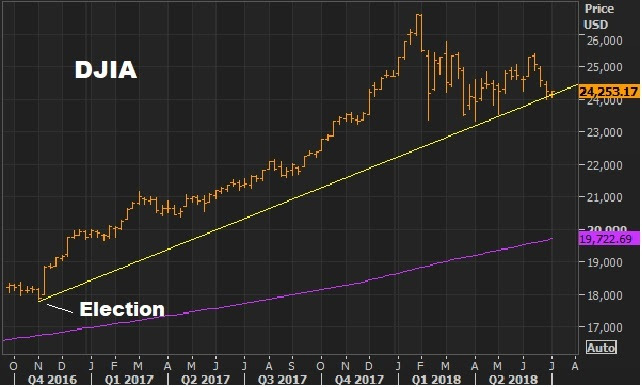
Yesterday we talked about the set up for the Dow. In the past couple of trading sessions, it traded perfectly into the trendline (support) that represents the run in stocks following the 2016 election.
It’s especially compelling when we consider that the Dow has been the laggard coming out of the broad stock market correction. As I said yesterday, this sets up for a second half where money should aggressively move back toward the blue chips.
With this in mind, I want to revisit some analysis I talked about last July. It’s from billionaire investor Larry Robbins (of the hedge fund Glenview Capital).
Robbins looked back at the important influence of low interest rate environments on stocks. He said “every time ONE of these following conditions has existed, the market has produced positive returns.
Here they are again:
When the 30-year bond yield begins the year below 4%, stocks go up 22.1%.
When investment grade bonds yield below 4%, stocks go up 16%.
When high yield bonds yield below 8%, stocks go up 11.6%.
When cash as a percent of asset for non-financials is above 10%, stocks go up 17.6%.
When the Fed tightens 0-75 basis points in the year, stocks go up 22%.
When oil falls more than 20%, stocks go up 27.5%.
His study showed that there has NEVER been a down year in stocks, when any ONE of the above conditions is met.
Now, we looked at this last year this time, and the S&P 500 finished up close to 20% on the year. It also worked in 2015. And it worked in 2016.
Does it apply this year? All apply, with the exception of oil. Oil is UP, big. And assuming the Fed hikes one more time this year. Still, as Robbins said, we need just ONE of these conditions to be met. The point is, low interest rates tend to make stocks go UP. That’s because global capital tends to reach for more risk to get return in a world where risk-free bonds aren’t compensating them enough.
Bottom line: Ignore all of the geopolitical noise. Low rates continue to tell us stocks will go up. And to make it easy for us, the DJIA is starting today at essentially the zero line — flat on the year!
Join our Billionaire’s Portfolio today to get your portfolio in line with the most influential investors in the world, and hear more of my actionable political, economic and market analysis. Click here to learn more.
As we head in to the holiday week, markets will likely go quiet until we get Friday’s jobs number.
We’re now into the second half of the year. After stocks got out to a huge start in January (up 7% in just the first 18 trading days of the year), we’ve since had a textbook correction of about 12%. And we currently sit up only 1% in the S&P 500 for the year. And the Dow is still down, -1.8%.
But we have this chart on the Dow that looks very intriguing…
The DJIA is trading perfectly into the trendline that represents this post Trump-election rally.
Given that technical backdrop, the underperformance of the Dow relative to small caps and tech stocks, and a 16 P/E, the blue-chip American companies are a bargain in a world of sub-3% ten-year yields.
This sets up a second half, where money aggressively moves back toward the blue chips.
Remember, as we worked through the price correction in stocks for the first half, we were awaiting Q1 earnings to show the early signs of fiscal stimulus working on the economy. We got it. We had big positive surprises on an earnings season that was already projected to do nearly 20% earnings growth.
Now, as we enter the second half, we should start to see the positive surprises in the economic data.
If you haven’t joined the Billionaire’s Portfolio, where you can look over my shoulder and follow my hand selected 20-stock portfolio of the best billionaire owned and influenced stocks, you can join me here.
Last week, we talked a lot about oil, as OPEC was meeting to deliberate on the status of their agreement to cut production.
While oil prices have been rising aggressively over the past year, the markets haven’t been paying a lot of attention — distracted by Trump watching.
But then Trump put it on the front burner, with another jab at OPEC on Twitter. And the media and Wall Street began trying to deduce the OPEC outcome. In the end, they misinterpreted. OPEC’s agreement to go from overcutting to complyingwith the initial levels of production cuts, means they are still cutting.
So, the market is still undersupplied in a world where demand has proven to be underestimated. That’s a formula for higher prices.
That’s what we’ve had for the past year, and that’s what we’ve gotten since OPEC’s official statement on Friday. In my note last Friday, I said “the lack of enough action from OPEC may serve as a catalyst to push oil much higher from here. That, of course, serves OPEC’s interests.”
Oil prices have exploded! We’ve seen a $10 pop since Friday morning. That’s 15% in a week. And I suspect it’s going to keep going.
Remember, we’ve talked about the prospects for $100 oil this year. Leigh Goehring, one of the best research-driven commodities investors on the planet has been telling us that since last year. And he’s looking spot-on at the moment.
Bottom line: This script is precisely what we’ve been talking about, here in my daily ProPerspectives note, since the price of oil was in the $40s. We’ve talked about the prospects for a return to $80 oil, and maybe even as high as $100 oil. And it looks more and more possible, given the surging demand and the supply shortfall.
How can you play it. On this thesis for oil, in my Billionaire’s Portfolio, we added SPDR Oil and Gas ETF (symbol XOP) and Phillips 66 (symbol PSX) back when oil prices were deeply depressed (in 2016). We followed the activism of policymakers (both central banks and OPEC). And in the case of PSX, we also followed Warren Buffett.
Both are up big, but have a lot more room to run. Oil and gas stocks (which comprise the XOP) have yet to reflect the supply shortfall in the oil market, much less the booming demand that is coming from an improving global economy (which many have underestimated).
If you haven’t joined the Billionaire’s Portfolio, where you can look over my shoulder and follow my hand selected 20-stock portfolio of the best billionaire owned and influenced stocks, you can join me here.
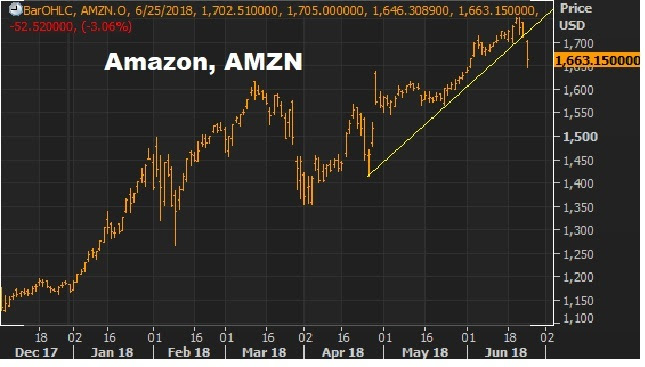
We’ve talked about the case for a shakeout in Amazon. It was up big today on news that it would be buying a big online pharmacy.
That worked to curtail the slide in the stock (for now). But it only exacerbates the building regulatory scrutiny and the President’s wrath against Amazon’s developing monopoly and power (much of which has been garnered overtime from the unfair advantages Amazon has enjoyed from operating as an internet company).
If there’s one thing we know about Trump as a President, he’s done what he says he’s going to do. And he’s had plenty of verbal threats directed squarely at Amazon. We can only assume that he will carry out the offensive he’s been promising — against a company that has crushed industries by price wars.
On a similar note, let’s talk about China. As we’ve discussed quite a bit, China’s rapid economic ascent in the world came through currency manipulation. They held their currency down, to underprice the world on exports. And as the world stood by and watched (and bought lots of stuff from them), they became the world’s second largest economy, and the accumulated the largest war chest of foreign currency reserves.
China is to the world, as Amazon is to corporate America. And Trump is attempting to deal with them both head on.
Interestingly, China is quietly fighting back, via the currency. The go to tool in China is currency devaluation.
That’s what they’ve been doing over the past three months. And that has accelerated in just the past 10 days – they’ve devalued by almost 4% against the dollar. This is something to watch closely. A big one-off devaluation out of China would be a geopolitical cage rattling.
Join our Billionaire’s Portfolio today to get your portfolio in line with the most influential investors in the world, and hear more of my actionable political, economic and market analysis. Click here to learn more.
While the media continues to be stuck on the global jawboning about trade. We’ve been talking about the continued domestic “leveling of the playing field.”
We’ve seen the verbal and Twitter shots taken by Trump at the tech giants since he’s been in office. And the threats have slowly been materializing as policy.
Late last year, we talked about the repeal of the Net Neutrality rule. And now we have the Supreme Court ruling that subjects internet sales to state tax.
Before you know it, the tech giants (Facebook, Amazon, Netflix, Google …) may actually be held to a similar standard that their “old economy” competitors are held to. They may have to pay for real estate (i.e. bandwidth). They may be liable for content on their site, regardless of who created it. And they may be scrutinized more heavily for anti-competitive practices.
That means, the costs may go UP for these companies. And the cost may go UP for consumers. But a more balanced and stable economy and society may come with it.
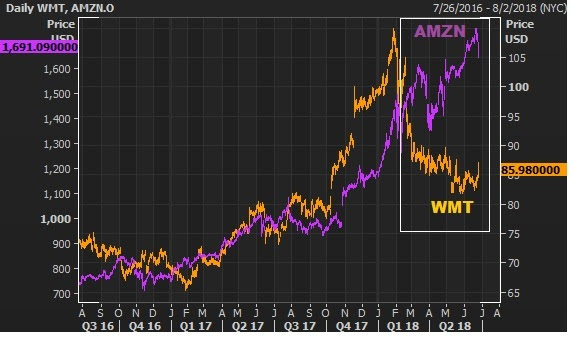
So, the balance of power is shifting, just as people were becoming convinced that Amazon was taking over the world. As we’ve discussed, if the market starts pricing OUT the prospects of Amazon becoming a monopoly, then the jaws may be closing on this chart …
Join our Billionaire’s Portfolio today to get your portfolio in line with the most influential investors in the world, and hear more of my actionable political, economic and market analysis. Click here to learn more.
Last Thursday we talked about the important Supreme Court ruling, which would subject internet sales to state tax. As I said, this was another “level the playing field” step for the Trump administration. And another shot across the bow of the tech giants — the near monopolies that have destroyed industries over past decade, in large part to the regulatory advantages they’ve enjoyed relative to their old-line industry peers.
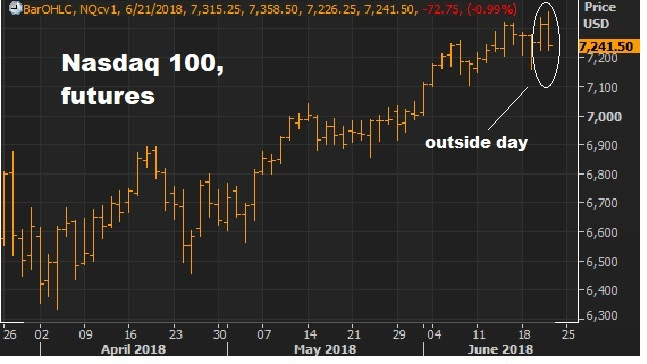
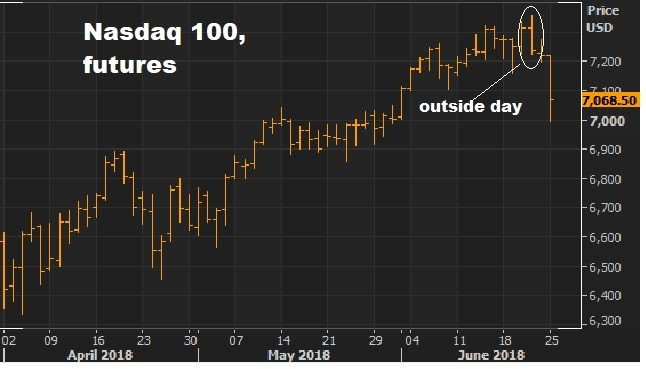
With that, on Thursday, we looked at this big reversal signal that developed in the tech-heavy Nasdaq — an ominous signal for the tech giants.
Today, we got this …
And this, in Amazon…
Meanwhile, what was UP on the day? Brick and mortar retail. Walmart was up 2%. Target was up 1%.
A lot of attention on the day, from the financial media, was given to trade threats. But this domestic “level of the playing field” is the real story.
Join our Billionaire’s Portfolio today to get your portfolio in line with the most influential investors in the world, and hear more of my actionable political, economic and market analysis. Click here to learn more.
We’ve talked about the big OPEC decision this week, and the prospects for oil prices.
When we get a market that thinks they know the outcome, we get a market that begins leaning too hard in one direction. And that creates an market outcome that can be asymmetric (i.e. lopsided). That’s what we had today.
In this case, Trump’s verbal attacks on OPEC’s price manipulation generated a media frenzy surrounding the OPEC meeting. And with the media swarming, the oil ministers seemed happy to oblige with commentary and pontification. And that set expectations for the outcome.
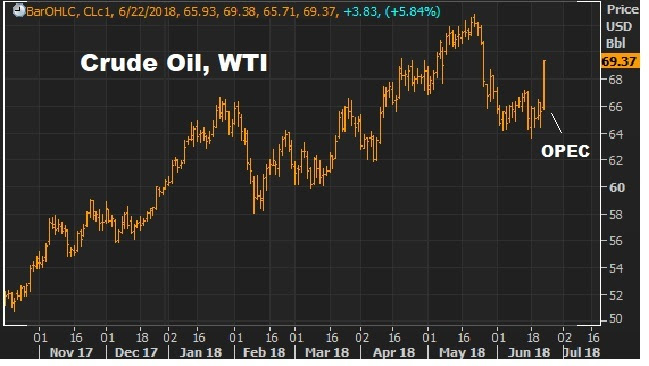
And this morning, OPEC released their communique, but it was far from the clean production increase the market was looking for. With that, we got this chart …
It went straight up. Oil was up almost 6% on the day and nearing $70 again. And this lack of enough action (as we should expect) from OPEC, to balance the oil market, may serve as a catalyst to push oil much higher from here (which serves OPEC’s interests).
And as we discussed yesterday, with high oil prices now squarely on the radar (for Trump, the media and the market), we may begin seeing oil prices weigh on stock prices.
Join our Billionaire’s Portfolio today to get your portfolio in line with the most influential investors in the world, and hear more of my actionable political, economic and market analysis. Click here to learn more.
We talked yesterday about the big influence of oil. And how the swings of the past few years have directly impacted the global economy.
Too low was threatening another global financial crisis. Now, too high is threatening to choke off the strength of the economic recovery.
Both high and low prices have been manipulated by OPEC. And we now await a decision from OPEC nations on whether or not a they will hike production to curb the level of oil prices. For a group that operates for their best interest, it doesn’t seem to be in their best interest. That decision will be announced tomorrow at a press conference.
Given the attention the Trump has given to OPEC and oil prices recently, a negative surprise (i.e. no production hike) may trigger the oil price/stock market inverse correlation trade (oil goes up, stocks go down).
On that note, we have some negative momentum going into tomorrow. Before today’s close, the Nasdaq was up 14% year-to-date. Meanwhile, the S&P 500 is up just around 3%. That’s a lopsided market.
But today we get a big outside day (key reversal signal) in the Nasdaq futures.
And the catalyst for this technical reversal setup was the Supreme Court ruling today that internet sales should be subject to state tax.
We’ve talked about the building scrutiny from the Trump administration facing the tech giants. This is another “level the playing field” step. If Amazon is pricing in the prospects of taking over everything (i.e. monopoly), this is the shot across the bow.
Join our Billionaire’s Portfolio today to get your portfolio in line with the most influential investors in the world, and hear more of my actionable political, economic and market analysis. Click here to learn more.
Stocks continue to prove resilient in the face of trade war noise. After a global stock sell-off that started last night on news that the tit for tat tariff threats were escalating, small caps actually printed another new record high today and finished up on the day.
Bottom line: Dips continue to be bought.
In the category of “stocks that can soar even on tumultuous market days?”
We had these three charts today …
The first two stocks are biotech. If you have much experience in investing, you’ll know that biotech stocks can cut both ways (most of the time, painfully).
Here’s my pro tip: ONLY BUY BIOTECH STOCKS WHEN A BILLIONAIRE INVESTOR IS INVOLVED!
Who was involved in the two above?
Not surprisingly, the best biotech investor in the world, billionaire Joe Edelman of Perceptive Advisors, is the biggest shareholder in SLDB.
He was also the biggest investor in Sarepta until it quintupled back in 2016 on an FDA approval. Sarepta was up as much as 50% today on early trial results of gene therapy treatment of the devastating Duchenne Muscular Dystrophy (DMD) disease in boys. SLDB is similarly working on gene therapy for DMD.
What about SandRidge (the energy stock)? SandRidge was up nicely today, in a broadly down market, because billionaire activist Carl Icahn successfully de-seated a corrupt board of directors at the post-bankruptcy energy company. That board and leadership that drove the company into bankruptcy, yet has been handsomely compensated in the process, has finally been shown the door. Great news for shareholders.
Join our Billionaire’s Portfolio today to get your portfolio in line with the most influential investors in the world, and hear more of my actionable political, economic and market analysis. Click here to learn more.
We’ve talked about the case for much higher oil prices since I started writing this daily note back in January of 2016. And we’ve since had a triple off of the February 2016 bottom.
The crash in oil prices from 2014 to 2016 was induced by OPEC as an effort to crush the competitive U.S. shale industry. While they nearly succeeded, these oil producing countries nearly killed their own economies in the process. So, in effort to drive oil prices higher, to salvage oil revenues, they had to flip the switch in late 2016, cutting production for the first time since 2008. And they did so, in a market that was already undersupplied. And in a world where demand has been underestimated, and growing.
So now, we’ve had this big recovery – nearly a round trip back to those 2014 levels.
The problem? The oil price crash was a threat to the global economy, as bankruptcies were lining up and deflationary forces were returning in the global economy. But now, current oil prices (and higher) are threatening to the recovery too, specifically the economic gains from fiscal stimulus.
And that’s on the wrong side of Trump. So, we’re seeing pressure on OPEC from the White House.
Will OPEC comply?
They are meeting now to determine whether or not they stick with current policy, or make an increase to production.
The expectations have been set for an increase. But there is dissension in the ranks at OPEC. If they surprise markets and maintain current output (i.e. no increase), we could see oil move much higher, and quickly. That would throw a wrench in almost everything. Remember, Trump’s tough positioning has a lot to do with the leverage he gets from a strong economy. $100 oil would threaten the economic outlook, and change the face of trade negotiations and the geopolitical environment.
We will likely hear leaks on Friday and probably hear a decision from OPEC on Saturday.
Join our Billionaire’s Portfolio today to get your portfolio in line with the most influential investors in the world, and hear more of my actionable political, economic and market analysis. Click here to learn more.