November 29, 5:00 pm EST

Today I want to talk about the decline in Bitcoin. 

As we often see with markets, people tend to confuse forced capital flows with genius.We’ve seen it in the tech giants.  The “disrupters” in Silicon Valley were only able to  disrupt long-entrenched industries because of the hundred billion dollars that flowed from Washington to Silicon Valley as part of the American Recovery and Reinvestment Act.  When the government is pouring that kind of money into “new technologies”, private equity (i.e. pension fund money) will follow it.  Plenty of funding, regulatory advantage, and no pressure to (in some cases, ever) produce a profit turns out to be a recipe for destroying industries.  The entrepreneurs are credited for their genius, but they have those capital flows from Washington, at the depths of the economic crisis, to thank for it.

Bitcoin is another case of confusing capital flows with genius.  It’s no coincidence that the ascent of Bitcoin coincided perfectly with the crackdown on capital flight in China.  In late 2016, with rapid expansion of credit in China, growing non-performing loans, a soft economy and the prospects of a Trump administration that could put pressure on China trade, capital was moving aggressively out of China.  That’s when the government stepped UP capital controls — restricting movement of capital out of China, from transfers to foreign investment.

Of course, resourceful Chinese still found ways to move money.  Among them, buying Bitcoin. And that’s when Bitcoin started to really move (from sub-$1,000). China cryptocurrency exchanges were said to account for 90% of global bitcoin trading. Capital flows were confused with Silicon Valley genius.

But in September of last year China crackdown on Bitcoin – with a totalban.  A few months later, Bitcoin futures launched, which gave hedge funds a liquid way to short the madness. Bitcoin topped the day the futures contract launched.

With the above in mind, I want to copy in my Pro Perspectives note from last December where I discussed the Bitcoin bubble.

THURSDAY, DECEMBER 7, 2017

With all that’s going on in the world, the biggest news of the day has been Bitcoin.
 
People love to watch bubbles build. And then the emotion of “fear of missing out” kicks in. And this appears to be one.
 
Bitcoin traded above $16,000 this morning. In one “market” it traded above $18,000 (which simply means some poor soul was shown a price 11% above the real market and paid it).
 
As we’ve discussed, there is no way to value Bitcoin. There is no intrinsic value. To this point, it has been bought by people purely on the expectation that someone will pay them more for it, at some point. So it’s speculation on human psychology.
 
Let’s take a look at what some of the most sophisticated and successful investors of our time think about it…
 
Billionaire Carl Icahn, the legendary activist investor that has the longest and best track record in the world (yes, better than Warren Buffett): “I don’t understand it… If you read history books about all of these bubbles…this is what this is.”
 
Billionaire Warren Buffett, the best value investor of all-time: “Stay away from it. It’s a mirage… the idea that it has some huge intrinsic value is a joke. It’s a way of transmitting money.”
 
Billionaire Jamie Dimon, head of one of the biggest global money center banks in the world: “It’s not a real thing. It’s a fraud.”
 
Billionaire Ray Dalio, founder of one of the biggest hedge funds in the world: “Bitcoin is a bubble… It’s speculative people, thinking they can sell it at a higher price…and so, it’s a bubble.”
 
Billionaire investor Leon Cooperman: “I have no money in Bitcoin. There’s euphoria in Bitcoin.”
 
Billionaire distressed debt and special situations investor, Marc Lasry: “I should have bought Bitcoin when it was $300. I don’t understand it. It might make sense to try to participate in it, but I can’t give you any analysis as to why it makes sense or not. I think it’s real, as it coming into the mainstream.”
 
Billionaire hedge funder Ken Griffin: “It’s not the future of currency. I wouldn’t call it a fraud either. Bitcoin has many of the elements of the Tulip bulb mania.”
 
Now, these are all Wall Streeters. And they haven’t participated. But this all started as another disruptive technology venture. So what do billionaire tech investors think about it…
 
Billionaire Jerry Yang, founder of Yahoo: “Bitcoin as a digital currency is not quite there yet. I personally am a believer that digital currency can play a role in our society, but for now it seems to be driven by the hype of investing and getting a return, as opposed to transactions.
 
Mark Cuban: He first called it a “bubble.” He now is invested in a cryptocurrency hedge fund but calls it a “Hail Mary.”
 
Michael Novagratz, former Wall Streeter and hedge fund manager. He once was a billionaire and may be again at this point, thanks to Bitcoin: “The whole market cap of all of the cryptocurrencies is $300 billion. That’s nothing. This is  global. I have a sense this can go a lot further. He equates it to an alternative (or replacement) for the value of holding gold – which is an $8 trillion market… over the medium term, this thing is going to go a lot higher.” But he acknowledges it shouldn’t be more than 1% to 3% of an average persons net worth.
 
Now with all of this in mind, billionaire Thomas Peterffy, one of the richest men in America and founder of the largest electronic broker in the U.S., Interactive Brokers, has warned against creating exchange-traded contracts on Bitcoin. He says a large move in the price could destabilize the clearing organizations (the big futures exchanges), which could destabilize the real economy.
 
With that, futures launch on Bitcoin on Sunday at the Chicago Mercantile Exchange. This is about to get very interesting.

That was the top.

What stocks do you buy?  Join me here to get my curated portfolio of 20 stocks that I think can do multiples of what broader stocks do, coming out of this market correction environment.
November 28, 5:00 pm EST

Yesterday we talked about the perfect setup, coming into today’s scheduled speech by the Fed Chair, for Powell to signal a pause in the Fed’s rate normalization program.

The sharp fall in oil prices in the past two months has taken some of the edge off of inflation concerns.  And there has already been evidence that the speed at which rates have moved has caused a slowdown in housing. So this was the perfect opportunity for the Fed Chair to give a clear signal that they are near the end on rate normalization.

Indeed, that’s what we got.  And that did indeed provide a positive catalyst for stocks, and I suspect it will be a positive catalyst for what has been some deterioration of confidence in the economic outlook.

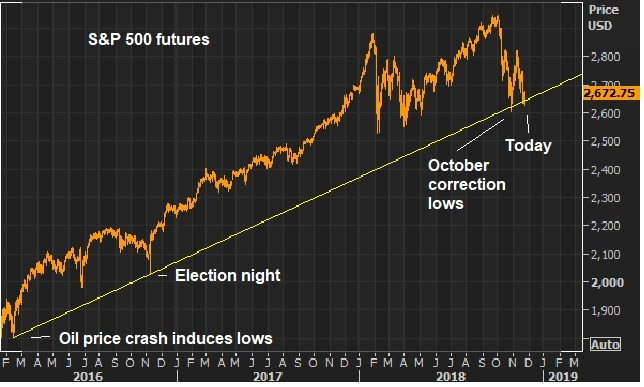
That all aligns nicely with the technical picture we’ve been watching in stocks.

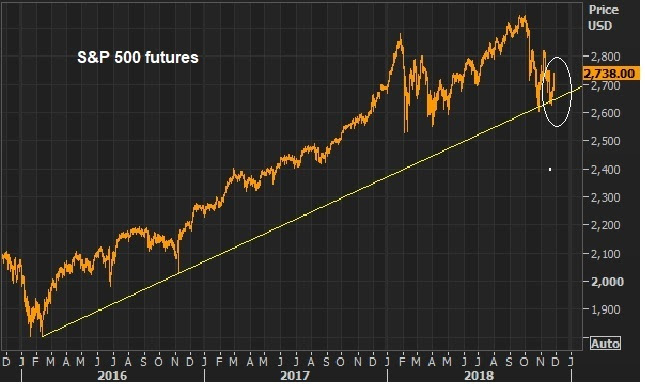
Here’s another look at the bounce off of this big trendline for stocks, that continues to grow in scale.

So this adjustment in the market’s perception on the interest rate outlook is a catalyst for what could be a very aggressive rebound in stocks into the year end.  More fuel would be a positive outcome from the Trump/Xi meetings on U.S./China trade, which will come toward the end of the week.

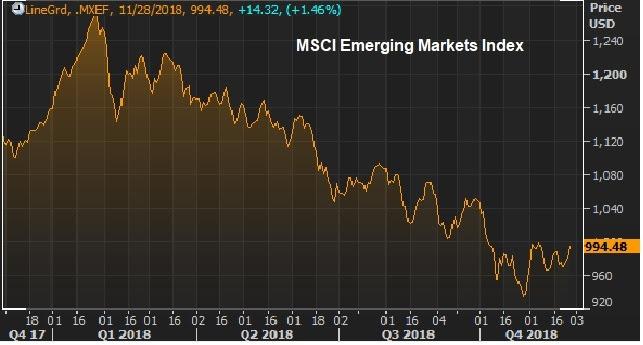
With the above in mind, among the biggest rebounds in global markets should be emerging markets.

As of last month, the MSCI Emerging Markets Index was down 27% from the January highs.
What stocks do you buy?  Join me here to get my curated portfolio of 20 stocks that I think can do multiples of what broader stocks do, coming out of this market correction environment.
November 27, 5:00 pm EST

Earlier this month, we talked about the big fall in oil prices.

If we look back over the past five years, the magnitude of that move is only matched (or exceeded) in cases where there was significant manipulation in the oil market and/or a systemically threatening oil price crash.

As we’ve discussed, the pressure on oil this time around seems to be about manipulation — and appears to have everything to do with Trump’s leverage over the Saudis (related to sanctioning the Kingdom over the Khashoggi murder).

But we’ve now traded down to the important $50 mark.  That’s 35% from the highs of just October 3.  And this is an inflection point where it could go bad, but it also could present a goldilocks scenario (a level that’s just right for the U.S. economy).

Sure, cheap oil is good for consumers.  You save a few extra bucks at the pump.  But in the current environment, it presents risks to the financial system.  The shale industry’s break-even point on producing oil is said to be $50.  Below that, they dial down production, lay off workers, stop investing and quickly become a default risk to their creditors (U.S. and global banks).  We saw it back in 2016.  The same can be said for those countries heavily dependent on oil revenues (i.e. they become default risks as oil prices move lower).

That’s the bad side. The good side to the oil price slide?  As we’ve discussed, it should relieve some pressure on the Fed. The Fed likes totalk about their inflation readings excluding effects of volatile oil prices.  But they have a record of acting on monetary policy when oil is moving.

The bottom line: Oil plays a big role in their view on inflation.  And given the quick drop in oil prices, the Fed’s concerns about inflation should be cooling. Again, this opens up the door for the Fed Chair, tomorrow, to take the opportunity in a prepared speech at the Economic Club of New York, to signal a pause coming in the Fed’s rate normalization program. That would be a positive catalyst for economic and market confidence.

What stocks do you buy?  Join me here to get my curated portfolio of 20 stocks that I think can do multiples of what broader stocks do, coming out of this market correction environment.
November 26, 5:00 pm EST

After a down 7% October, the S&P 500 was down another 3% for November as we started the week.

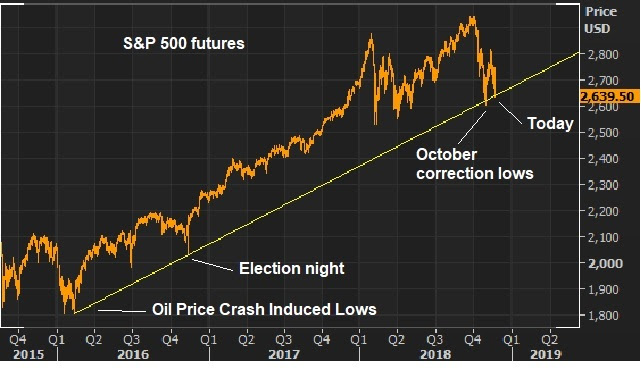
But stocks had a nice day, continuing to bounce from this big trendline we’ve been watching over the past week.  

And the better news:  We have potential positive catalysts on the docket for this week that could put a final stamp on this correction.

Powell (Fed Chair) gives a prepared speech on Wednesday at the Economic Club of New York.  Remember, we were looking for some signal a couple of weeks ago that the Fed might take a pause normalizing rates.  We got it, but from the Atlanta Fed President.  This week, any indication from the Fed Chair that rate hikes are nearing an end would be a greenlight for stocks.

And then we get new information on U.S./China trade relations by the week’s end as Trump and Xi are scheduled for a sit down at the G20 meetings.  Among all of the concerns that might be curbing risk appetite (both in markets and the economy) this one is among the biggest.  Progress on that front should also trigger relief in stocks.

The combination of a more dovish Fed and some clarity on trade would set up for what could be a very aggressive bounce for stocks into the year end.

What stocks do you buy?  Join me here to get my curated portfolio of 20 stocks that I think can do multiples of what broader stocks do, coming out of this market correction environment.

November 21, 5:00 pm EST

We looked at the below chart yesterday.  We’re continuing to get a bounce off of this big trend line that incorporates the lows of the oil price crash of 2016, and the election later that year. 

Importantly, as I said yesterday, the stock declines of this year appear to have everything to do with Saudi capital flows — and less to do with all of the hand-wringing issues you hear and read in the financial media.

As we discussed last month, the top for stocks in January and the top in October, both align perfectly with the timing of events in Saudi Arabia.

Let’s revisit that timeline from my October note: “Remember, last November the Saudi Crown Prince Salam, successor to the King, ordered the arrest of many of the most powerful Saudi Princes, country ministers and business people in Saudi Arabia on corruption charges. More than $100 billion in assets were claimed to be under investigation (a third frozen) in what was called the “Saudi purge.”

These subjects were detained for nearly three months. The timing of their release and the market correction of early this year is where it all begins to align.

They were released on Saturday, January 27. S&P futures open for trading on Sunday night. Stocks topped that night and proceeded to drop 12% in six days. And rallies in stocks were sold aggressively for the better part of the next seven months.

Fast forward to this month and we have the murder of the journalist who was a public critic of the Crown Prince Salam. As the details of story pointed back to Salam, on October 3, U.S. bond markets got hit (to the hour of news hitting the wires) and stocks topped that day, and have proceeded to drop by more than 8%.

Clearly, the destabilization in Saudi Arabia has put considerable assets in jeopardy. With that, those in control of those assets have likely been scrambling to protect them, as U.S. Congress pushes for sanctions, which could include freezing Saudi assets.”

Now, over the past few weeks, we’ve seen some back and forth onwhether or not the Saudi Crown Prince would be implicated in the Khashoggi murder and/or, most importantly, sanctioned.  And the moves in stocks have been reflecting that whipsaw.  Remember, the Saudi sovereign wealth fund is worth more than half a trillion dollars.  They’ve been heavily invested in the tech giants.  And those (the tech giants) have led the way down.  Any uptick in the probability that we see more U.S.-based Saudi assets frozen or threatened, has created selling in stocks.

But as we said yesterday, Trump seems to be settled on the sanctions that have already been levied (excluding the Crown Prince and broader government).  That’s a positive for stocks.

And he’s leveraging the Saudi crisis to get oil prices lower.  Remember, we talked about the oil bargaining chip earlier this month.  Here’s an excerpt from my November 9 note:  “It’s probably no coincidence that the slide in oil prices started the day that the Saudi Crown Prince was implicated in journalist Jamal Khashoggi’s disappearance. Remember, the bond market got hit, to the hour, of this headline hitting …
Stocks topped a few hours later, and that was the top for oil prices too.
When Trump spoke with the Saudi Crown Prince on the phone on October 16, oil was trading above $71. We haven’t seen that level since.
Trump‘s position on high oil prices is no secret. He doesn’t like it. And Saudi Arabia is well aware. Is it possible that Trump has leverage and is using it? Likely. Is it possible that the Crown Prince is willing play ball with U.S. demands (on oil production) in order to avoid sanctions (or worse).
Interestingly, Trump is now confirming the above with his statements over the past couple of days.
Bottom line:  When stocks decline for non-fundamental reasons, it’s a huge buying opportunity.  This is one of those moments.
What stocks do you buy?  Join me here to get my curated portfolio of 20 stocks that I think can do multiples of what broader stocks do, coming out of this market correction environment.
Have a great Thanksgiving!

November 20, 5:00 pm EST

Stocks hit this big trendline today and bounced.

This line comes in from the oil price crash-induced lows of 2016.  And, as you can see, we have the bottom of the fallout in the futures market on election night, and the lows of last month. This area also puts the S&P 500 right at a 10% decline from the October highs.

Is it the bottom of this sharp two-day slide?  Maybe.

Let’s talk about why stocks have gotten hit, again, this week.

Last week, it looked like the fog had lifted.  We were looking for the Fed to signal a pause on rates.  We got it, to a degree, with the message that the ‘normalization phase’ for rates was in the “final days.”  We had the U.S. Treasury name those Saudis to be sanctioned in the Khashoggi murder.  The Crown Prince wasn’t one of them – which means the Kingdom was not being sanctioned.  And we had news that progress was being made on U.S. China trade.  That was all good news for stocks.

But the latter two of these hurdles for stocks was reversed over the weekend.

We had some confrontational talk from Pence and Xi.  And we had news that the CIA investigation would implicate the Crown Prince in the murder of Khashoggi.

Everyone is well aware of the U.S./China trade implications.  As for the Saudi, implications, it’s more complicated.  First, Trump has been trying to make the case for Saudi Arabia’s critical alliance in the fight to defeat ISIS and check of Iran.  Maybe more importantly, pushing Saudi Arabia toward an alignment with China and Russia in the long-game would be a grave danger for the U.S.

Taking action against the Crown Prince would jeopardize both.

So, as I suggested earlier in the month, Trump seems to be leveraging the Saudi crisis to get oil prices lower.  He said as much today. And to this point, it appears that he’s settled on the sanctions that have already been levied.

If that holds, that’s good for stocks.  The risk, given the amount of wealth Saudi Arabia has in U.S. capital markets, is any change in that stance that might mean broad sanctions on the Kingdom of Saudi Arabia.  That’s where Saudi liquidations, in effort to secure assets, is dangerous for the stock market.

Join me here to get all of my in-depth analysis on the big picture, and to get access to my carefully curated list of “stocks to buy” now.

November 19, 5:00 pm EST

The tech giants continued to get hammered today.  We’ve talked about the prospects for an unraveling of the tech giants for much of the past year.

Despite the clear warning shots that were fired by regulators/lawmakers (and the President) along the way, these stocks kept going up — until they didn’t.

As I said back on September 4th, when Amazon crossed the trillion-dollar valuation threshold, “at 161 times earnings, the market seems to be betting on the Amazon monopoly being left to corner all of the world’s industries. That’s a bad bet. Much like China undercut the compeition on price and cornered the world’s export market, Amazon has undercut the retail industry on price, and cornered the world’s retail business. That tipping point (on retail) has well passed. And as sales growth accelerates for Amazon, so does the speed at which competition is being destroyed. But Amazon is now moving aggressively into almost every industry. This company has to be/will be broken up.

A day later, Facebook and Twitter executives visited Capitol Hill for a Congressional grilling.  Here’s an excerpt from my note that day:  “If you listened to Zuckerberg‘s Congressional testimony in April, and today’s grilling of Jack Dorsey (Twitter) and Sheryl Sandberg (Facebook), it’s clear that they have created monsters that they can’t manage. These tech giants have gotten too big, too powerful and too dangerous to the economy (and society).

Here we are, a little more than two months later, and the sentiment on tech has dramatically changed.  Amazon topped the day it reached the trillion-dollar valuation and has lost a quarter of a trillion dollars in value since (down 26%).  Facebook is down 39% since the record highs in July.

So it appears that we are finally seeing the “monopoly scenario” priced out of the tech giants.  And with that, we should see money moving back into those stocks that have been left for dead in industries like media, retail, shipping (to name a few).  This is the Dow/Nasdaq convergence we’ve been looking for for much of this year — and we’re getting it.  At one point this summer the Nasdaq was up close to 15% on the year, while the Dow was flat.  Now both are up just over 1% year-to-date.  I suspect that Dow outperformance will continue.

We have G20 tomorrow, where the world will be watching for some movement on the U.S./China trade negotiations.  Any hint at a deal should get this Dow trade moving aggressively higher.

Join me here to get all of my in-depth analysis on the big picture, and to get access to my carefully curated list of “stocks to buy” now.

November 16, 5:00 pm EST

Stocks end the week on a strong note.

We’ve talked all week about the catalysts to fuel the continuation of recovery in the stock market.  The Fed’s signalling that their rate normalization program is in the final steps was a big one.  We’ve also possibly cleared the overhang of the potential for broad sanctions on the Saudi government.  And now we’re getting movement on the China/U.S. trade negotiations.

Again, just in the past few days we’ve cleared a lot of the fog that has been hanging over stocks.

With that, as we head into the weekend, let’s take a look at a few charts …

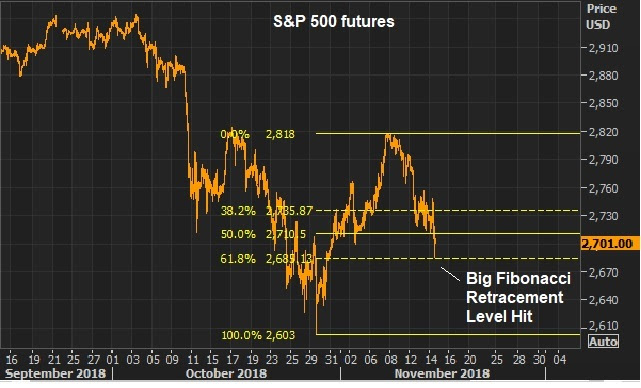
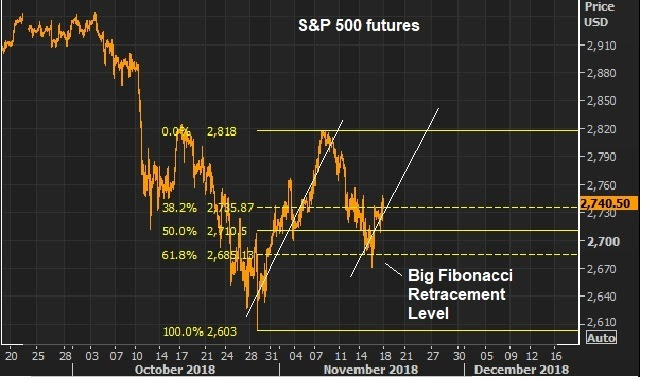
On Wednesday, we looked at this chart above.  This big retracement level was setting up nice, technically, for another leg higher in the post correction recovery for stocks.  It looks like we’re getting it.

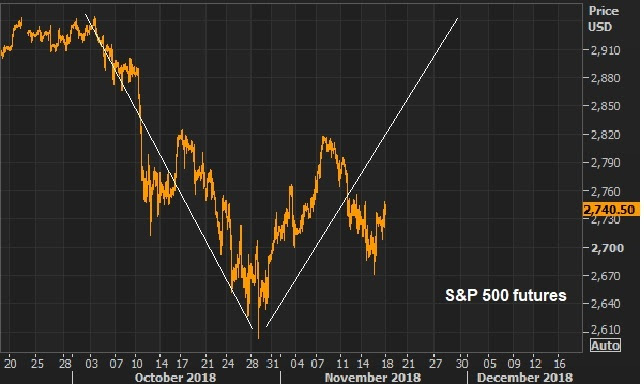
And I continue to think this may all end in a sharp V-shaped recovery.  In the chart below, you can see what the slope of that move may look like.  

The stock market fears are driven by “what-ifs.”  Meanwhile the reality (the “what is”) is clearly supportive of much higher stock prices: strong economic growth, subdued inflation, strong corporate earnings and cheap valuations.
Have a great weekend!
Join me here to get all of my in-depth analysis on the big picture, and to get access to my carefully curated list of “stocks to buy” now.

November 15, 5:00 pm EST

One of the spots weighing on the market has been the Fed’s persistent increase in interest rates.  With that, and with some soft spots showing in the global economy and a more challenging policymaking environment ahead in Washington, we were watching Fed Chair Powell’s remarks very closely late yesterday (after the market close) for some signalling that a pause on rate hikes might be coming.

Unlike past Fed heads, Powell is a plain spoken guy.  And he tends to be very clear in his messaging.  With that, he didn’t seem to have an agenda for sending a clear signal to markets yesterday. But he did have some dovish takeaways.  He said they are at the point where they have to take seriously the risk of moving too far and stifling the recovery and not moving far enough to manage inflation. On that note, he acknowledged that the level of interest rates are weighing on the house market.  And he said signs of a global slowdown are concerning.  So, he tells us they’re watching the data closely for next moves, and then he tells us some data is suggesting slowing.

Now, it’s common for other Fed governors to be out talking, between meetings, in an effort to set market expectations. With that said, the bigger signalling came today.  The Atlanta Fed President and a voting Fed governor on monetary policy (Bostic), had a prepared speech in Madrid today.  He said the Fed is in the final steps of getting to the neutral rate (which means neither accommodative nor restrictive).  He said that’s where they “want to be” and then said he thinks the neutral rate is between 2.5% and 3.5%. Rates are currently 2%-2.25% (almost the low end of his neutral range).  And he said they should proceed cautiously with rate increases.  Bottom line:  These statements suggest the Fed could be done with the ‘normalization’ process of rates after one or two more hikes.

So, we were looking for the Fed to use the weakening global growth data this week (from Japan and Europe), some softer global inflation data, and the changes in Congress, as an excuse to dial down the market’s expectations for the path of rates.  It was subtle, but I think we’ve seen it.

Indeed, stocks ripped higher on Bostic’s comments this afternoon.  The Dow jumped about 1.5% today as the comments hit the news wires.

Moreover, we’ve had some more uncertainty removed from marketsin the past 24-hours.  We now have trade discussions re-opened between China and the U.S.  And today, the U.S. Treasury has named the individuals that will be sanctioned in Saudi Arabia, regarding the murder of Khashoggi.  To this point, the Saudi Crown Price isn’t one of them, which means the Saudi government is not being sanctioned.

It’s been a violent six weeks for stocks, but the lows from late October remain well intact.  And we may now be clear for another recovery leg of this recent broad market correction.

Join me here to get all of my in-depth analysis on the big picture, and to get access to my carefully curated list of “stocks to buy” now.

November 14, 5:00 pm EST

Later today Fed Chair Powell will be speaking at a Dallas Fed event.  We’ve talked over the past two days about the potential for Powell to use this opportunity to dial down expectations of a December rate hike.

Overnight, Japan reported a contraction in their economy for the third quarter. And this morning Germany’s GDP report showed the first contraction in more than three years. Meanwhile, U.S. core CPI came in softer than expected this morning.  And the headline number will be hit, in the next reading, by a 28% plunge in oil prices.

Add this to the outlook for gridlock in Washington on any further pro-growth policy-making, and Powell has the perfect excuse to start telegraphing a pause on rate hikes.

If he does, expect stocks to respond very favorably.  We will see.  He speaks at 6:05pm EST.

Here’s a look at stocks and the decline of the past month, as we head into this Fed discussion on the economy …

Technically, today the S&P and the Dow both hit a big retracement level and bounced aggressively.  This sets up nicely for the Fed discussion.
Join me here to get all of my in-depth analysis on the big picture, and to get access to my carefully curated list of “stocks to buy” now.