
|
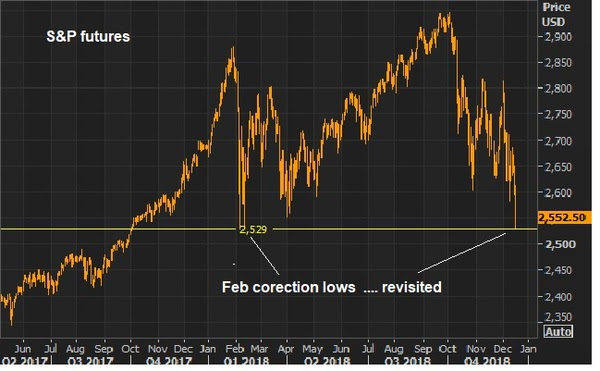
December 14, 5:00 pm EST
We’ve talked about the struggling Chinese economy this week.
As I’ve said, much of the key economic data in China is running at or worse than 2009 levels (the depths of the global economic crisis).
And the data overnight confirmed the trajectory: lower.
As we’ve discussed, this lack of bounce in the Chinese economy (relative to a U.S. economy that is growing at better than 3%) has everything to do with Trump squeezing China.
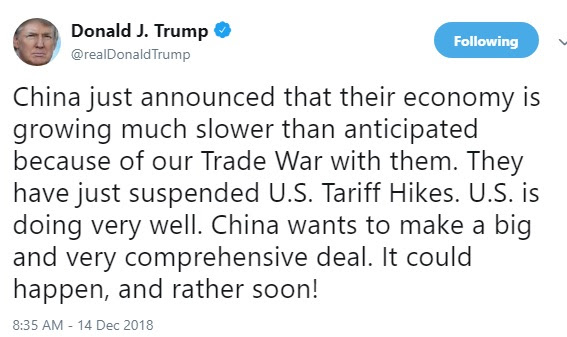
He acknowledged it today in a tweet ….
The question: Has China retaliated with more than just tit-for-tats on trade? Have they been the hammer on U.S. stocks? It’s one of the few, if not only, ways to squeeze Trump. As we discussed last week, when the futures markets re-opened (at 6pm) on the day of mourning for the former 41st President, there was a clear seller that came in, in a very illiquid period, with an obvious motive to whack the market. It worked. Stocks were down 2% in 2 minutes. The CME (Chicago Mercantile Exhange) had to halt trading in the S&P futures to avert a market crash at six o’clock at night.
Now, cleary stocks have a significant influence on confidence. You can see confidence wane, by the day, as stocks move lower. And, importantly, confidence fuels the decisions to spend, hire and invest. So stock market performance feeds the economy, just as the economy feeds stock market performance. The biggest threat to a fundamentally strong economy, is a persistently unstable stock market. In addition, sustaining 3% growth in the U.S. will be difficult if the rest of the world isn’t participating in prosperity.
With that in mind, in my December 1 note, I said “it may be time for Trump to get a deal done (with China) and solidify the economic momentum needed to get him to a second term, where he may then readdress the more difficult structural issues with China/U.S. relations.” That seems even more reasonable now.
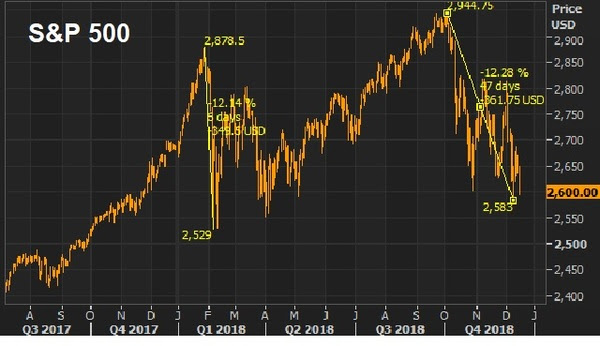
We have two 12% declines in stocks this year. And you can see the fear beginning to set in. With that, the best investors in the world have made their careers by “being greedy when others are fearful” (Warren Buffett) or “buying when most people are selling and selling when most people are buying” (Howard Marks). There is clear value in stocks right now.
December 12, 5:00 pm EST
We talked about the China trade story yesterday.
In a nutshell, Trump has capitalized on an aligned Congress (in the first half of the mid-term) to stoke the U.S. economy. And that has strengthened the leadership position of the U.S. coming out of the decade long post-global economic crisis period.
With that, Trump has used the leverage of global economic leadership (in a vulnerable global economic period) to force change in China. And as we observed yesterday (in the charts of Chinese GDP, industrial production, domestic investment and retail sales), he’s getting movement because the Chinese economy was sputtering before the trade crackdown, and is now running out of gas. Much of the key economic data in China is running at or worse than 2009 levels (the depths of the global economic crisis). We get new data on industrial production, domestic investment and retails sales out of China tonight. This should provide more information on how the Chinese economy is being squeezed.
As for stocks, we have eleven trading days remaining for the year. The S&P 500 finishes today down about 1% for the year, and down 3.4% month-to-date. On the quarter, stocks are down 9% — the worst fourth quarter since 2008. If we look back at monthly returns, dating back to 1950, stocks have finished UP in December 75% of the time, for an average gain of 1.5%. Only two times have stocks has worse December performance over the near 70 year period (2002 and 1957).
And remember, as we discussed earlier this week, it’s not just stocks. It’s a zero (or near zero) return year for all major asset classes this year. Stocks, bonds, gold, real estate … nothing is working. The winner on the year has been cash.
|
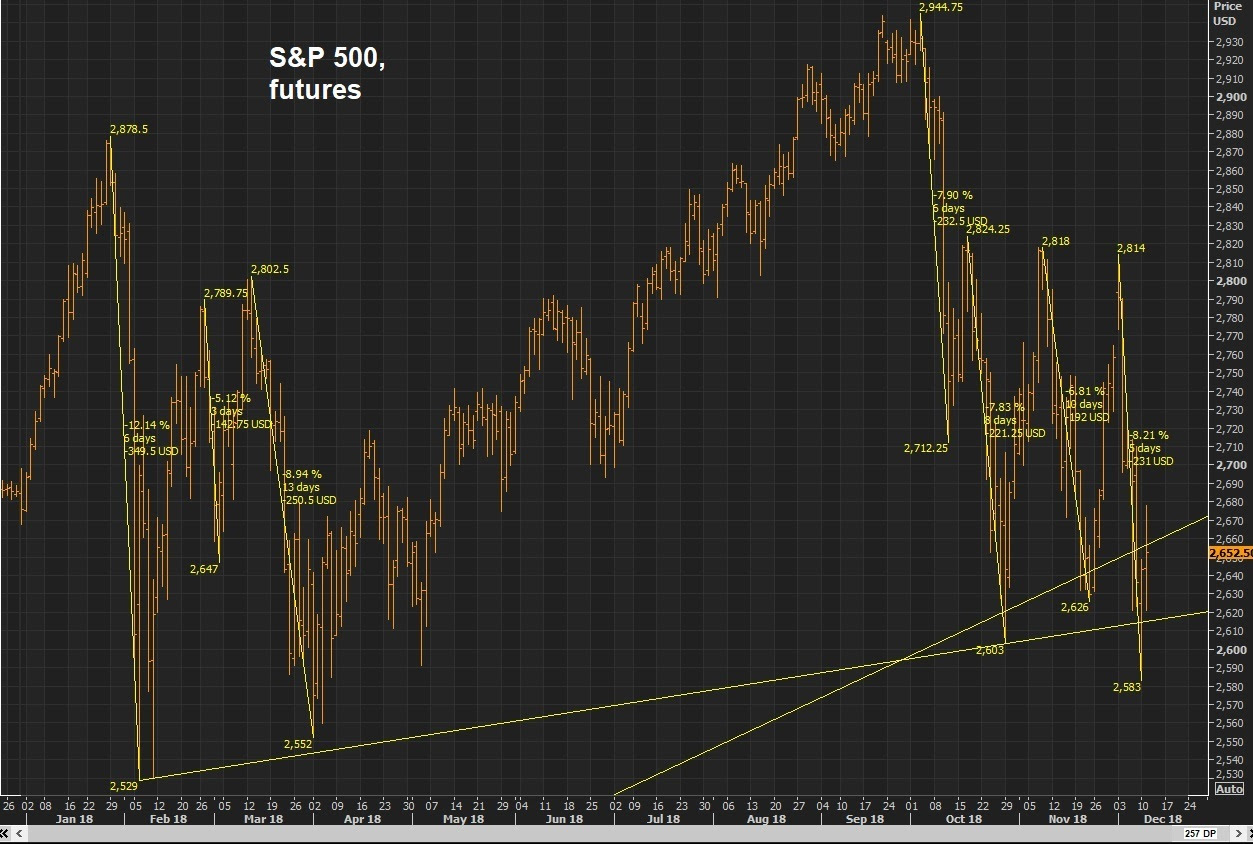
December 11, 5:00 pm EST We’ve talked about the market volatility the past few days. Let’s take a look at a chart of the many swings in stocks for the year. |
|
|
 |
|
You can see we’ve had seven significant declines this year. A clear observation in this chart is that the declines are fast. As they say, the market goes up on an escalator and down in an elevator. We’ve had a 12% decline over six days. A 5% decline in three days. A 9% decline in thirteen days. An 8% decline in six days (to open October). A 7.8% decline in eight days. A 6.8% decline in ten days. And, this recent, 8.2% decline in five days (assuming yesterday was the bottom). So, the seven declines of the year have averaged 8%, over a period of seven days. This argues that we probably have, indeed, seen the low on this recent sharp slide. And that leaves us, at today’s close, with a stock market trading at 15 times earnings — among the cheapest valuation we’ve seen only two times in the past 26 years. What stocks do you buy? Join me here to get my curated portfolio of 20 stocks that I think can do multiples of what broader stocks do, coming out of this market correction environment. |
December 10, 5:00 pm EST
On Friday we talked about the rise in market volatility, and what’s driving it.
It’s regime change. For the better part of a decade we had an economy driven by monetary stimulus (and loads of central bank intervention to absorb any potential shocks to markets). And since the election, we now have an economy driven by fiscal stimulus and structural reform.
But as I said Friday, with dramatic change, the pendulum can often swing a little too far in the opposite direction at first (from little-to-no volatility to a lot, in this case).
As it stands, stocks are now down about 1% on the year. In normal times you would see other alternative asset classes (to stocks) performing well. Bonds would be the obvious winner — but if you owned 10-year notes you would be down about 3% on the year (about flat after the yield). When stocks are down, and uncertainty is rising, gold tends to do well. Not this year. Gold is down 4.5% on the year. What about real estate. The Dow Jones Real Estate index is up, but small (+1.8%). Among the best investments of the year is cash. If you owned 1-month T-bills all year, you would be up close to 2%. I suspect this dynamic of little-to-no return asset class alternatives will change very soon.
December 7, 5:00 pm EST
Last year, the stock market broke a 21-year old record of the most consecutive days without a 3% intraday drawdown — some 240+ straight days.
We’ve now had a 3% intraday drawdown (open to low) three times since just early October.
So, what is responsible for the rise in volatility? Why such a contrast from last year?
It’s regime change. After nine years of zero interest rates and trillions of dollars of QE, the torch was passed this year. We entered the year with big tax cuts to implement.
This was the official transition from a monetary policy-driven economic recovery, to a fiscal stimulus-driven recovery. The Fed passed the economic stimulus torch to the White House.
Now, there was good reason that volatility remained subdued under the Fed’s emergency level zero-interest-rate policy. Why? The Fed told us, explicitly, that they (and other major global central banks) stood “ready to act” against any potential shocks that could disrupt the global economic recovery. That was an explicit promise to absorb risks so that investors (businesses, consumers, etc) would keep economic activity moving, by spending, hiring and investing.
The Fed (and other central banks, namely the ECB) had to be the backstop, so that people would pursue higher risk/return assets, in a world where risk-free assets yielded nothing. That was good enough to secure an economic recovery, but only at stall-speed levels of growth.
With that, as we entered the year, the U.S. economy was, for the first time in more than nine years, removing the central bank backstop (removing the life support for the economy). The gameplan: To replace low interest rates and QE with a $1.5 trillion fiscal stimulus package to catapult the economy out of the economic rut of 1% growth, and back toward sustainable 3% (trend) growth. And with that influence, the economy might have a chance to sustainably mend and breath on its own again.
So far we’ve gotten the growth (whether or not it’s sustainable has yet to be seen). But this regime change has also introduced uncertainty (and shock risks) back into the economy and markets. That resets the scale on volatility. And I think that adjustment has been underway.
With that said, the pendulum often swings a little too far in the opposite direction at first (from little-to-no volatility to a lot, in this case).
What stocks do you buy? Join me here to get my curated portfolio of 20 stocks that I think can do multiples of what broader stocks do, coming out of this market correction environment.
|
December 5, 5:00 pm EST
I was away from the markets yesterday, on a big down day. With markets closed today to honor the 41st President, let’s take a look at what happened on Tuesday.
Why the ugly and persistent plunge in stocks?
Many of the reasons that have been attributed to the two stock market corrections this year, bubbled up again yesterday. But as we’ve discussed, the stock declines this year appear to have had everything to do with Saudi capital flows–and less to do with all of the hand-wringing issues you hear and read in the financial media. Same can be said for yesterday.
When prospects rise that Saudi assets may be threatened by sanctions(or seizures in the case earlier this year, related to the Crown Prince’s corruption crackdown) indiscriminate and aggressive selling of U.S. assets hit immediately (likely led by the Saudi sovereign wealth fund, which has assets over half a trillion dollars).
We had it again yesterday. Stocks had a big gap up on Monday on movement on U.S./China trade. It was after the close on Monday that the news hit that the CIA would brief the special Senate committee on Tuesday. Stocks immediately started moving lower. The Dow futures were down 250 points by midnight. And then of course, yesterday, when news hit that the briefing was underway (just after noon), the bottom immediately fell out of stocks. A little more than half an hour later, U.S. Senators were standing in front of cameras telling the world that the Crown Prince was involved in the murder and that Congress should invoke the Magnitsky Act. This law authorizes the government to sanction human rights offenders, freeze their assets, and ban them from entering the U.S.
With that, I suspect this was nothing more than grandstanding. Trump will not (can not) act for the reasons we discussed last month.
If he sanctioned the Saudi government over this, oil prices would probably explode and stocks would crash (not really an option).
We’ll see how stocks react tomorrow after a day of reflection. I suspect Tuesday created another buying opportunity.
|
|
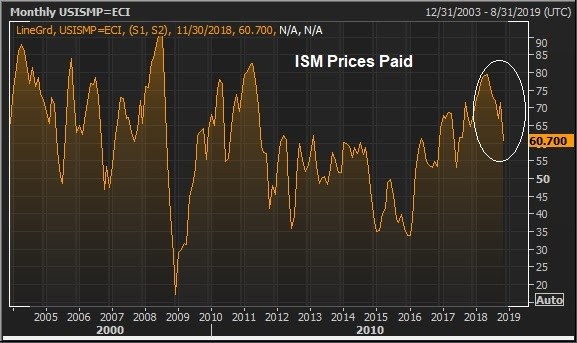
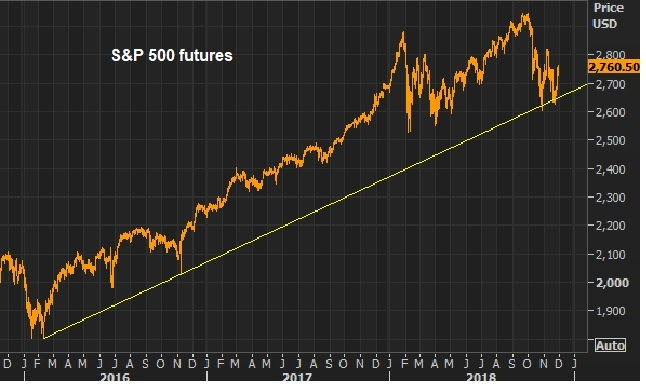
November 30, 5:00 pm EST As we close the week and month, let’s take a look at some key charts. Stocks have now bounced 5% since last Friday. And that bounce was technically supported by this big long-term trendline we’ve been watching … |
 |
|
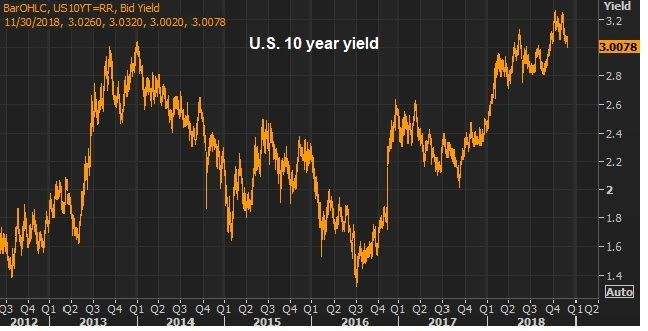
And, as of this week, stocks now have the additional fuel of a more stable outlook for interest rates. |
 |
|
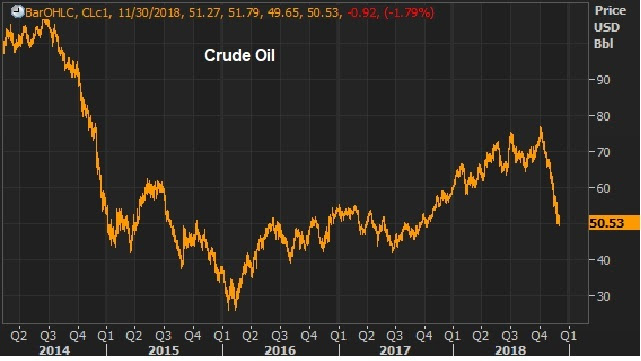
The surge above 3% on the ten-year yield sustained that level, even in the face of a stock market decline. That signal created fears that the Fed might be on course to choke-off economic momentum. But that has now been quelled by the Fed’s clear signal this week that they are near the end of their rate normalization program. The 10-year ends the week well off the highs of the past two months, and at the important 3% level. The dramatic adjustment lower in oil prices should also be additional fuel for stocks … |
 |
|
An overhang of risk to global markets has been the potential for sanctions on the Saudi government. But the issue seems to be now settled, with the sanctioning of Saudi individuals which do NOT include the Saudi Crown Prince and/or government. And as we’ve discussed, Trump has used the leverage over the Saudi Crown Prince to influence oil prices lower (for the moment). With that above in mind, stocks finish the week well bid. If we can get at least a standstill agreement on the U.S./China trade war from this weekends meetings between Presidents Trump and Xi, that may be enough to fuel a melt-UP to new highs on stocks by the end of December. It may be time for Trump to get a deal done, and solidify economic momentum to get him to a second term, where he may then re-address the more difficult structural issues with China/U.S. relations. What stocks do you buy? Join me here to get my curated portfolio of 20 stocks that I think can do multiples of what broader stocks do, coming out of this market correction environment.
|