|
January 15, 5:00 pm EST
We now have Q4 earnings in from three of the country’s four largest banks. Yesterday it was Citi. Better earnings were driven by cost cuts not growth. Still, the stock is up 8% in two days.
Today it was Wells Fargo and JP Morgan. Wells, too, had soft revenues but beat on earnings driven by cost cuts. JP Morgan missed on earnings and revenues.
Now, Jamie Dimon runs JP Morgan — the largest U.S. based global money center bank. And he has been publicly positive on the economy and the market outlook, in the face of a lot of broad negativity and fear late last year.
Let’s take a look at what he had to say about JP Morgan’s earnings and the operating environment…
JP Morgan generated record earnings and record revenues for full year 2018. And Dimon says they would have done it even without the tax cuts. He says his business shows the U.S. consumer to be healthy and engaged. Consumers are spending, saving and investing. And Dimon said they opened Chase branches in new states for the first time in nearly a decade.
This all in a year where the chatter about an impending recession grew by the month, for no other reason than the economic expansion has been running long.
According to the biggest bank in the country, things sound pretty good.
|
January 14, 5:00 pm EST Meaningful fourth quarter earnings kick off this week with the big banks. We heard from Citigroup this morning. They beat on earnings but on lower than expected revenues. The stock finished UP over 4%. We get JPMorgan and Wells Fargo Q4 earnings tomorrow before the open. Bank of America and Goldman Sachs will report on Wednesday. Remember, the turning point for stocks in December started with a call-out to the major banks by the U.S. Treasury Secretary. Not surprisingly, the turn in stocks was led by the banks. |
![]() |
|
You can see the big reversal in this chart of the KBW bank index. The index is now up 16% since December 26th. With the above in mind, one of the best value investors of the past twenty years, Jeffrey Ubben, has thought the timing is finally right for major banks. He has said the U.S. banking system has the lowest risk profile “than any time in our investing lifetime.” In our Billionaire’s Portfolio, we followed him into Citigroup, the highest conviction position in his $16 billion portfolio. It’s the cheapest of the four biggest U.S.-based global money center banks. As for earnings, overall: Remember, we’re coming off of three consecutive quarters of corporate earnings that blew away very lofty Wall Street estimates — 20%+ yoy earnings growth for the first three quarters of 2018. But sliding stocks in the fourth quarter eroded sentiment, and down came earnings estimates for Q4. The market is looking for just 10% earnings growth for the fourth quarter. For 2019, they’re looking for just 7%. This all sets up for positive surprises. Positive surprises are fuel for stocks.
Join me here to get my curated portfolio of 20 stocks that I think can do multiples of what broader stocks do, coming out of this market correction environment.
|
|
January 10, 5:00 pm EST
The coordinated response to market turmoil continues to reverse the tide of what was becoming an increasingly ugly global financial market meltdown.
Remember, we had a response from the U.S. Treasury Secretary on the days leading up to Christmas, which included call outs to the major banks and a meeting of the “President’s Working Group” on financial markets. Coincidentally, by the next Wednesday, a new item hit the agenda for the American Economic Association Annual Meeting. It was the January 4 live interview with the three most powerful central bankers in the world over the past ten years: Bernanke, Yellen and Powell. These three sat on stage together and massaged market sentiment on the path of interest rates, fortifying the market recovery that was started by the efforts of the Treasury.
Just in case we didn’t get the message, we’ve since had six Fed officials publicly dialing down expectations on the rate outlook, in response to financial markets. And we’ve had minutes from the Fed’s last meeting that clearly gave the message that the Fed could pause, sit and watch. And then today Powell was on stage again for another public interview, reiterating the Fed’s new position: on hold.
Join me here to get all of my in-depth analysis on the big picture, and to get access to my carefully curated list of “stocks to buy” now.
|
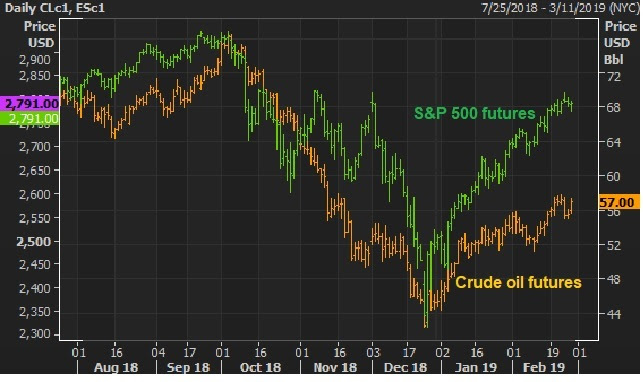
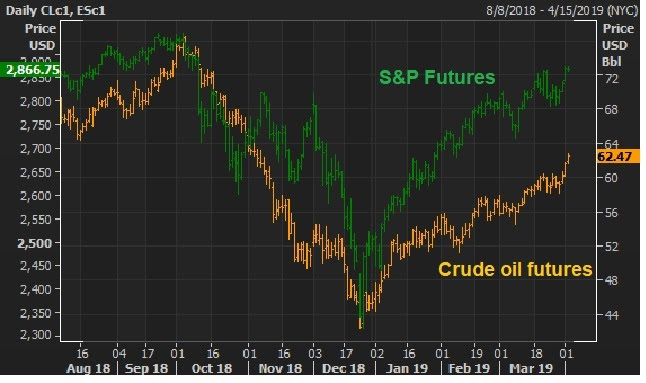
January 9, 5:00 pm EST We discussed yesterday how markets might look by the end of the year, if the pontifications about a global slowdown and impending crisis are dead wrong. The reality: That is the low probability outcome. The higher probability outcome is another 3%+ year growth in the U.S. in 2019, a resolution on the Chinese trade dispute, and a rebound in emerging market growth. With the “high probability scenario” in mind, let’s take a look at some key charts that look very vulnerable to a sharp squeeze. Remember, oil and stocks have been in a synchronized decline since October 3. On Friday we looked at this chart on oil, and the break of the big downtrend that accompanied some rate-hike relief jawboning from the Fed. |
![]() |
|
Today the chart looks like this …up almost 9% from Friday.
|
![]() |
|
Here’s the chart on stocks we looked at on Friday …
|
![]() |
|
We broke a big level on Friday at 2,520. We’re up another 2.3% since. What about yields? The fear in the interest rate market hasn’t been/wasn’t that the economy can’t withstand a 3% ten-year yield. The fear has been the speed at which the interest rate market was moving, and the methodical tightening process of the Fed. Would 3% quickly become 4%? The Fed has now backed off. That quells the fears of a “too far, too fast” adjustment in rates. But the interest rate market had already been pricing in the worst case scenario (another recession and crisis, in part thanks to the Fed policy). If that was an over-reaction, I suspect we’ll see a move back toward 3%-3.25% in the 10s in the coming months. As you can see in the chart, this big line is being tested today. And as long as the Fed stays data dependent, not telegraphing another series of hikes, the market should accept a 3% ten year yield just fine. |
![]() |
|
To sum up: Markets tend to be caught wrong-footed at the extremes — leaning too hard in one direction, with sentiment too depressed or too exuberant. And I suspect we’ve seen that extreme in Q4. Sentiment was deeply shaken by the sharp decline in stocks, and that spilled over into the outlook for global economic stability.
But as we discussed yesterday, we have a Q4 earnings season upon us that is set up for positive surprises (given the sharp downward adjustment in expectations). And if Trump gives some ground to get a deal done with China, these key markets are set up for big and sharp recoveries. Join me here to get my curated portfolio of 20 stocks that I think can do multiples of what broader stocks do, coming out of this market correction environment.
|
|
January 7, 5:00 pm EST
The Fed sent a message to markets on Friday that they will pause on rates hikes, if not stand ready to act (i.e. cut rates or stop shrinking the balance sheet), unless market conditions improve.
With that support, stocks continue to rebound. But as the market focus is on stocks, the quiet big mover in the coming months might be commodities.
Over the weekend, the President confirmed that the $5 billion+ border wall would be made of steel — produced by U.S. steel companies. Add to that, it’s fair to expect that the next item on the Trumponomics agenda, will be a big trillion-dollar infrastructure spend (an initiative believed to be supported by both parties in Congress).
Trump has also threatened to move forward with the wall under an executive order, citing national security. With that, the execution on the wall, regardless of the state of negotiations on Capitol Hill should be coming sooner rather than later.
Let’s take a look today at a few domestic steel companies that should benefit.
Nucor Corp (NUE)
Nucor corp is the largest steel producer in the United States.


As you can see, these stocks all benefited early on (post election) on the prospects of Trump’s America First economic plan. But, like the broader market, these stocks are all well off of the 2018 highs now — driven by the intensified trade dispute with China over the past year, the uptick in global economic risks, and the concern over Trumponomics policy execution with a split Congress. They look very, very cheap considering the outlook for domestic steel demand.
Disclosure: We are long Cliffs (CLF) in our Billionaire’s Portfolio.
Join me here to get my curated portfolio of 20 stocks that I think can do multiples of what broader stocks do, coming out of this market correction environment.
|
January 3, 5:00 pm EST
As we’ve discussed, the dysfunctional stock market has put pressure on Trump to stand down and make a deal with China.
And Apple’s CEO, Tim Cook, turned up that pressure yesterday. In a letter to investors, he warned that Apple, the biggest and most powerful company in the world, would have lower revenue in the quarter that just ended. The blame was placed on economic deceleration in China —due to the trade dispute.
Now, it’s clear that Cook wanted to draw attention to the impact of the trade dispute. And the media was happy to run with that story today.
But the slowdown at Apple last quarter also had a lot to do with “fewer iPhone upgrades than anticipated.” This was tossed into the context of slower economic activity in China, which makes it look like a macro issue. But Apple also has a micro issue. They seem to have exhausted the compelling innovation that has historically gotten iPhone users excited about buying the latest and greatest phone. The older models are still pretty great. No reason to upgrade.
So, Apple has used a violent market and slowdown in China, perhaps, in an attempt to divert attention away from the slowing device business.
The good news: Even if they don’t develop the next world-changing device, they have a services business (Apple pay, Apple Music, iCloud Drive, AppleCare and the iTunes App store) that is producing almost as much revenue as Facebook.
And the stock is incredibly cheap. On trailing twelve months, the stock trades at 12 times earnings. But if we back out the nearly $240 billion of cash Apple is sitting on, the business at Apple is being valued at $437 billion. That’s about 7 times trailing twelve month earnings.