July 28, 2019
If you haven't signed up for my Billionaire's Portfolio, join now — get your risk free access here.
July 26, 2019
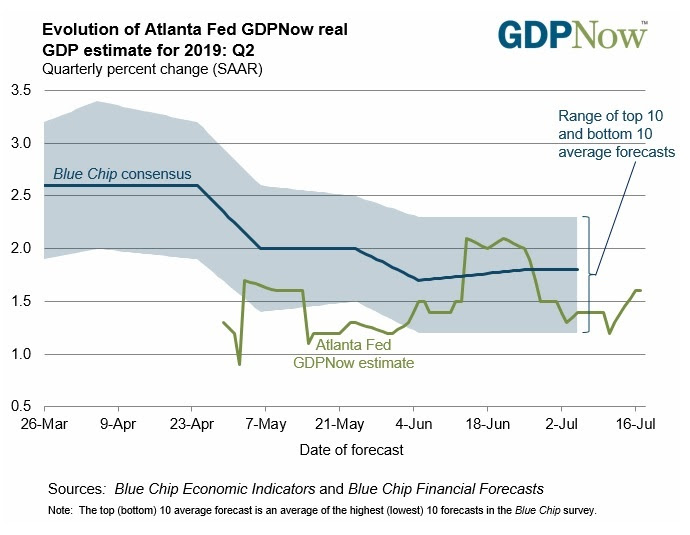
We did, indeed, get a positive surprise. The economy grew at 2.1% pace in the second quarter. That's better than the Wall Street estimate (1.8%), and a lot better than the Atlanta Fed's estimate of 1.3%.
As we've discussed over the past two weeks, the first half of Q2 earnings season has been better than expected, because of a strong consumer. With that, it was a safe bet that we would see the strong consumer show up in GDP this morning. Consumer spending was up 4% in the quarter. Domestic demand grew by 3.5%.
Things are pretty good.
 |
|
This leaves some people wondering if the Fed's case for rate cuts has been damaged.
The answer is no. While consumer confidence has been stabilized and underpinned by central bank rhetoric, business confidence has been a different story. And this is something the Fed has been emphasizing. Business fixed investment declined (in Q2) for the first time in three years. This is clear concern about an indefinite trade war — and monetary policy that is too tight, relative to the rest of the world, if trade protectionism were to spread and amplify. That's where the Fed has plenty of jusitification to make their move next week. If you haven't signed up for my Billionaire's Portfolio, join now — get your risk free access here.
July 25, 2019 We heard from the ECB this morning. Draghi was expected to step up his "ready to act" rhetoric, but was unlikely to do anything. That was the case.
As we discussed yesterday, an official change in policy direction by the Fed next week (cutting rates, a three year rate hiking campaign), should be enough to ease the pressure on the global economy, without requiring a move by the ECB and more stimulus from the BOJ. Let's talk about earnings and tomorrow's GDP report. The theme of the year has been concern about the slowing economy. While it hasn't reflected much in the data, the fear has been driven by the prospects of eroding global confidence. The first place that tends to show up is in financial markets. We saw it late last year, as U.S. and global stocks plunged. But if we look at how the consumer has done through the first half of 2019, there are no signs of a loss of confidence. The consumer discretionary sector is up 25% year-to-date, outperforming the broader market (which is up 20%). Earnings have continued to beat expectations in consumer related businesses. We saw it early in the earnings seasons in Q1 and Q2, from the performance of the consumer businesses within the big banks. Today, Starbucks gave us another barometer on the consumer (a beat on earnings, with 26% year-over-year earnings growth). Expedia, the online travel booking site beat on earnings, with 9% growth in booking revenue from the same period a year ago. Why has the consumer held in strong this year, in the face of a confidence shock to end 2018? The Fed (and global central banks) answered the call. The did what they've done for the past decade — promising to do whatever it takes to keep the economy moving forward, and to avert any economic shocks. That's enough to keep people spending and investing. But a trade deal will be needed (soon) to keep it going.
We get the first look at Q2 GDP tomorrow morning. The Atlanta Fed model is looking for just 1.3% growth in the quarter. With consumption contributing 70% of that reading, this GDP number looks setup for a positive surprise.
If you haven't signed up for my Billionaire's Portfolio, join now — get your risk free access here.
July 24, 2019 Over the next five business days we'll hear from the European Central Bank, the Bank of Japan and the Fed.
The ECB will kick it off tomorrow morning. And we head into this major central bank meeting with U.S. stocks sitting on new record highs. And with German bond yields trading very near record lows (at negative 37 basis points). We already know all three of these major central banks have made it clear over the past seven months that they will do more easing, more unconventional policies if needed. The question is, will the ECB, just seven months removed from ending its QE program, announce a new stimulative program? Will the BOJ add to its QE program? Doubtful. I suspect, a reversal of course by the Fed next week (from a three year rate hiking campaign, to cutting rates), will be enough to ease the pressure on the global economy, without more official action from the ECB and BOJ. Any pressure on the ECB and BOJ to do more would be further eased, if a U.S./China trade deal were to follow the Fed's move. The Trump administration appears to be putting the timeline in place. U.S./China trade negotiations will restart in China next Tuesday through Wednesday (the day we expect to get a Fed cut). And then the Treasury Secretary said today, they plan to have meetings come back to D.C. Remember, Trump is in the position of strength on the China negotiations. At anytime, he can make any concessions necessary to do a deal, and remove the overhang of uncertainty on the global economy. Heading into next year's election, he would have a tailwind of a booming economy. Now, with U.S. stocks sitting on record highs, let's take a look at a couple of stock market charts that should offer bigger opportunity over the next five months, following the global economic relief of a Fed pivot (rate cut). Here's a look at German stocks. The S&P 500 is on record highs, the DAX is 9% off of the record highs (from January of last year). |
 |
|
And here's a look at Japanese stocks. You can see the Nikkei looks like a technical breakout is coming (i.e. going higher). The S&P 500 is on record highs, and the Nikkei is 13% away from the October 2018 highs.
|
 |
|
If you haven't signed up for my Billionaire's Portfolio, join now — get your risk free access here.
July 23, 2019 Earnings continue to come in strong. Remember, we entered the earnings season with market expectations of a 3% decline in year-over-year in earnings.
With about a fifth of the companies now reported, close to 80% have surprised positively on earnings, on an earnings growth rate of about 7%. If we look at some of the blue chip American brands reporting today, the year-over-year earnings growth looks solid, if not strong. Kimberly-Clark, the paper/consumer products company, grew earnings by 5% compared to the same period a year ago. The big conglomerate, United Technologies grew earnings by 12%. Lockheed Martin grew earnings by 23%. With these three companies we get signals on three of the components of the economy: Consumption (Kimberly-Clark), Investment (UTX), Government Spending (LMT). The fourth component is net exports. One of the largest exporters in the S&P 500, International Paper, reports on Thursday. With the above in mind, we get the first reading on Q2 GDP this Friday, which is expected to have slowed from 3.1% in the first quarter, to 1.6% (Atlanta Fed's estimate) in the second quarter. Remember, we talked last week about the set up for positive surprises in earnings (which we're getting) AND in the economic data. This growth number looks like it includes an assumption of an economic storm. But in the word's of the Coca Cola CEO today, the storm (for Q2) never arrived. Add to that, any meltdown that might have been underway in global confidence, has been warded off by global central banks (either easing or setting expectations for easier financial conditions). If you haven't signed up for my Billionaire's Portfolio, join now — get your risk free access here.
July 22, 2019 On Friday, we talked about the strong Microsoft earnings.
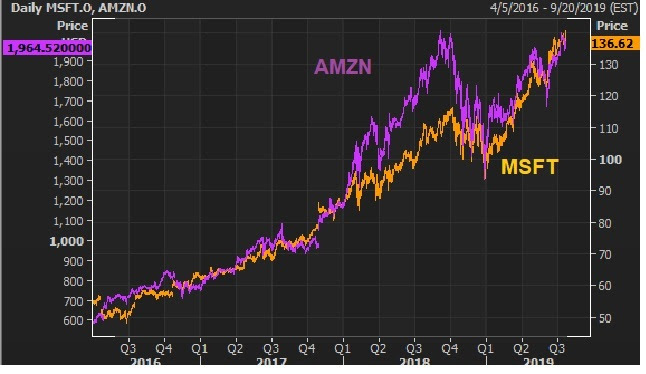
Thanks to the strategy reset that took place five years ago, Microsoft is part of the duopoly in cloud computing. And that has led Microsoft to stand alone (at the moment) as the only trillion-dollar company in the world. By the end of the week, we will likely see them joined (again) by the other half of the cloud computing duopoly, Amazon. When we think about the great "disrupters" of the past decade, and how the industries that they've disrupted will be left, when it has all shaken out, I think this MSFT/AMZN story is a good analog. The giants of industry, if they move aggressively with the disrupters, have the distribution to compete, if not beat, the disrupters. The Walmart/Amazon battle is another great example. The market has priced Amazon like a runaway monopoly — killer of all industries, especially retail. And the perception has been that Walmart was destined to become another rise and fall story of a dominant American retailer. Sears, Toys R Us and about 70 other retailers have gone under in the last four years.But Walmart has been transforming. Walmart has been aggressively investing in online. They bought Jet.com in 2016, an American online retailer. That same year they took a large stake in the number two online retailer in China, JD.com. Walmart now owns 12% of JD.
JD.com already has a big share of ecommerce in China. They are number two to Alibaba, but gaining ground due to some clear competitive advantages. JD owns and controls its logistics infrastructure, and does quality control from the supplier to delivery. And unlike Alibaba, JD sources product to its warehouses to fight the counterfeit goods risk – a big problem in China. JD has 500+ warehouses around the country, and they now source product and service customers from one of the more than 400 Walmart stores in China.
So Walmart is positioned well to take advantage of the growth in the middle class in China. Amazon has yet to find its way in China. It has about 1% market share. Add to this, Google came in last year with a $550 million investment to help position JD to challenge Alibaba and Amazon on a global scale. Walmart is still about a third of the value of Amazon, but the gap has been closing (slowly). Lastly, let's look at Netflix and the response underway at Disney. In recent years, Netflix has been thought to be taking over the entertainment industry with its disruptive direct-to-consumer model. Fox responded early and aggressively (thanks the activist investor, Jeff Ubben). They made an aggressive move to build the direct-to-consumer model (taking stakes in Hulu, Star India and Sky). That set the company up as an acquisition target. And now with the Disney acquisition of Fox, Disney is positioned with a dominant duel threat — among the world's deepest and most valuable library of content and the distribution to take it to the consumer. This makes the world's preeminent entertainment company. The result? Disney's valuation has leapfrogged Netflix. Disney now has a market cap of $250 billion. And Netflix has plunged $50 billion in value, to a market cap of $135 billion, since the Disney/Fox marriage last year. If you haven't signed up for my Billionaire's Portfolio, join now — get your risk free access here.
July 16, 5:00 pm EST Today we heard from two more of the “big four banks” on Q2 earnings. Yesterday, Citi kicked it off with 11% earnings growth compared to the second quarter of last year. This morning, JP Morgan beat expectations, reporting 23% yoy earnings growth. Wells Fargo followed with an earnings beat, growing earnings by 32% yoy. The banks continue to put up big numbers. And it’s, in large part, thanks to consumer banking. With record low unemployment, record high net worth and record high credit worthiness, the consumer business is strong. Last year, one of the best value investors of the past twenty years, Jeff Ubben, said the U.S. banking system has the lowest risk profile “than any time in our investing lifetime.” A decade following the financial crisis, he thought the timing is finally right for major banks. He has been right. With that in mind, if we look back at the sector weightings in the S&P 500, financials were the heaviest weighted sector in the years leading up to the financial crisis — at 22% of the index. The financials currently make up just 13% of the S&P 500. Meanwhile, the average P/E on the big four banks is just better than 10 – well below the long-term average on the broader market of 16. The banks are cheap (still). If you haven’t signed up for my Billionaire’s Portfolio, join now — get your risk free access here.
|